


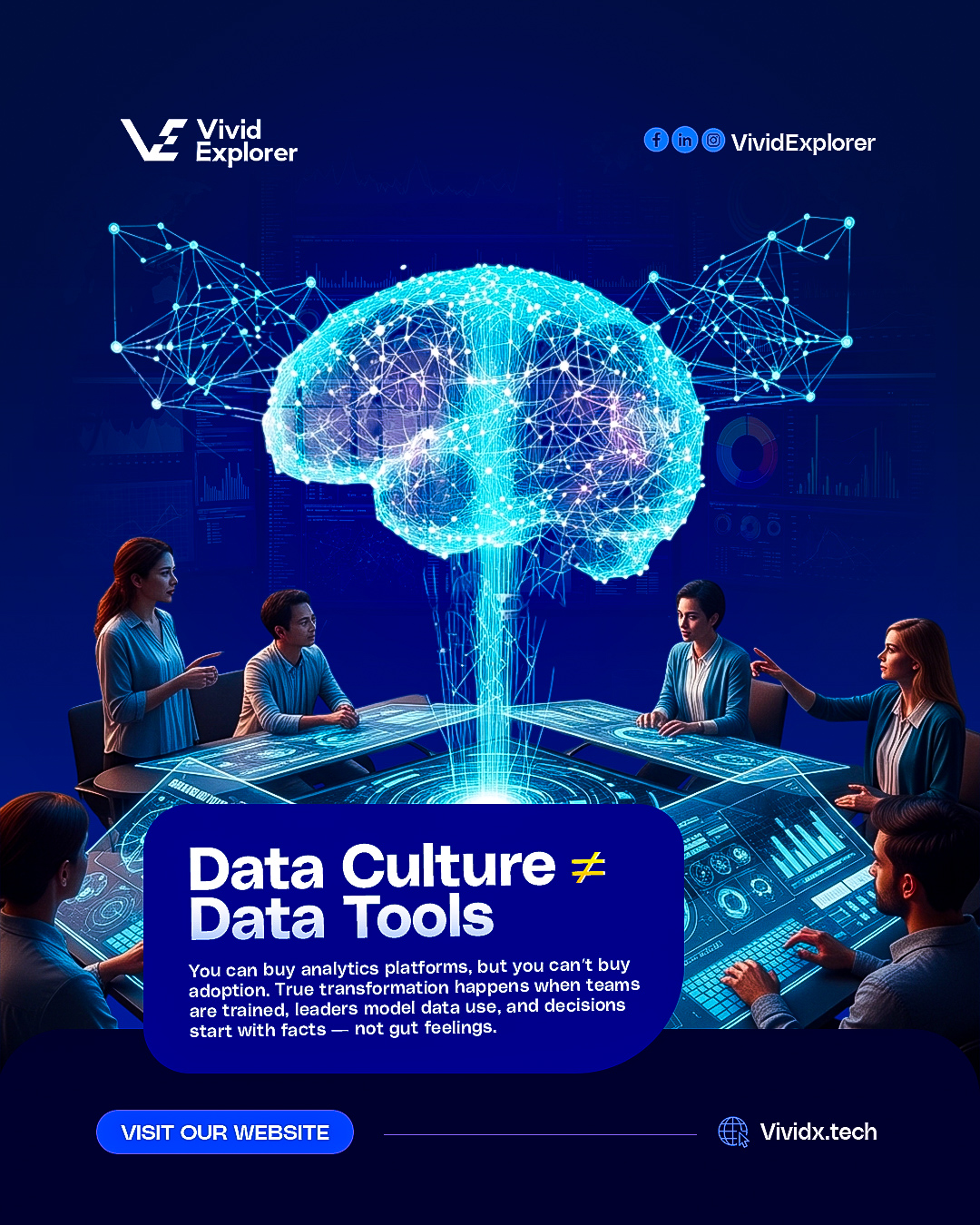
Data Culture ≠ Data Tools: Why People, Not Technology, Drive Transformation
Leadership plays a pivotal role. Executives who consistently reference data in strategy sessions, make evidence-based decisions, and celebrate wins driven by insights inspire the entire organization to adopt a data-first mindset. Culture begins at the top and behavior is contagious. When leaders model the behavior they want to see, teams naturally follow.Many organizations believe that buying the latest analytics software, dashboards, or AI platforms will automatically make them “data-driven.” The promise of cutting-edge technology is seductive: advanced features, predictive models, real-time reporting, all available at the click of a button. Yet, despite these investments, a shocking number of companies fail to see meaningful results. Why? Because tools alone cannot create a data-driven culture. Transformation happens not with software, but with people who understand, embrace, and act on data.
Imagine this scenario: your organization invests in a powerful analytics platform. The dashboards are visually stunning. The data is accurate. Yet, weeks pass, and adoption is slow. Teams hesitate to trust the numbers. Decisions are still based on gut instincts. Leaders occasionally glance at reports but continue relying on experience and intuition. The tools are there, but nothing changes. This is a common story, and it highlights a critical truth: technology enables insights, but culture drives action.
Building a true data-driven culture is about people, leadership, and processes working together. It’s about creating an environment where data is not just available, but embedded in every decision, conversation, and strategy.
Empowering Teams: The Human Side of Data
For most organizations, the first hurdle is people. Teams often lack the confidence or skill to interpret data and apply insights effectively. This is where training, coaching, and empowerment become crucial. Employees need more than access, they need guidance on how to think analytically, challenge assumptions, and make decisions based on evidence.
When teams feel empowered, they move from passive tool users to active contributors of change. They begin asking better questions, spotting patterns, and identifying opportunities that would otherwise go unnoticed. A data tool without an empowered team is like a telescope in a dark room, it has potential, but no one knows how to use it.
Leadership as the Catalyst for Change
Culture begins at the top. Leaders are the blueprint for behavior, and their actions signal what the organization values. When executives consistently use data in strategy sessions, make evidence-based decisions, and celebrate wins driven by insights, it inspires the entire organization to follow suit. Conversely, if leadership continues to rely on intuition alone, even the most sophisticated tools will fail to gain traction.
A simple example: a leader reviewing a sales dashboard during weekly meetings, highlighting key insights, and explaining how decisions were influenced by the data, not only reinforces the importance of analytics, it normalizes a data-first mindset across the organization. Culture is contagious, and leadership sets the tone.
Integrating Data into Everyday Decision-Making
True data culture isn’t about dashboards sitting in a corner of the office or reports emailed monthly. It’s about integrating insights into daily workflows, meetings, and operational decisions. Every strategy discussion, every project review, and even routine team huddles should start with evidence, not opinion.
Embedding data in decision-making involves three things:
- Consistency: Make data the first reference point for decisions.
- Accessibility: Ensure insights are clear, actionable, and understandable for every role.
- Accountability: Encourage teams to act on insights and track the impact of those actions.
When data becomes part of the organization’s rhythm, decisions are no longer reactive, they are informed, predictive, and strategic.
Why Tools Alone Fail
Organizations often invest in flashy tools but neglect the human and cultural factors. The consequences are predictable:
- Low adoption: Surveys show that over 60% of enterprise analytics platforms are underutilized. Teams either don’t understand them or fail to see relevance.
- Misaligned expectations: Software features are pursued without alignment to workflows or business objectives.
- Cultural neglect: Technology cannot instill curiosity, accountability, or analytical thinking—these are human behaviors cultivated intentionally.
Vividx’s Strategic Approach: People, Process, Technology
At Vividx, we know that lasting transformation happens when technology, people, and processes work in harmony. We go beyond installing tools:
- People: We train teams to interpret insights, develop analytical thinking, and act decisively.
- Processes: We embed data into daily workflows, making insights actionable in real-time.
- Leadership alignment: We coach leaders to model data-first behavior, ensuring adoption cascades through the organization.
This holistic approach turns analytics from a “nice-to-have” into a driver of measurable business outcomes. Organizations see faster adoption, better decisions, and tangible results.
The Bottom Line
Investing in tools without cultivating culture is like buying a high-performance engine but forgetting the fuel. The result? No movement, no impact, no transformation. The organizations that thrive prioritize people first, culture second, and technology third.
At Vividx, we help businesses turn tools into transformation by building a culture that makes data actionable, habitual, and impactful. Because at the end of the day, it’s not the tools you buy that drive success, it’s how your people use them to create real, measurable impact.
Similar publication
 Business Speed Increased. Manual Processes Didn't Survive.
Manual processes do not announce their inefficiency. They just quietly consume the time, attention, and accuracy your business needs to…
Read More AI adoption shifted from "experiment" to "essential advantage."
78% of organizations now use AI in at least one business function. The experiment is over. The question is no…
Read More The Future of Data Collection and Its Impact on Business
Data collection is evolving from passive accumulation to intentional design. As real-time systems, distributed architectures, and privacy-first frameworks reshape how…
Read More Why Data Doesn’t Change Behavior, People Do
Organizations today are rich in data but often unchanged by it. The gap is not in insight, but in behavior.…
Read More