 Vividx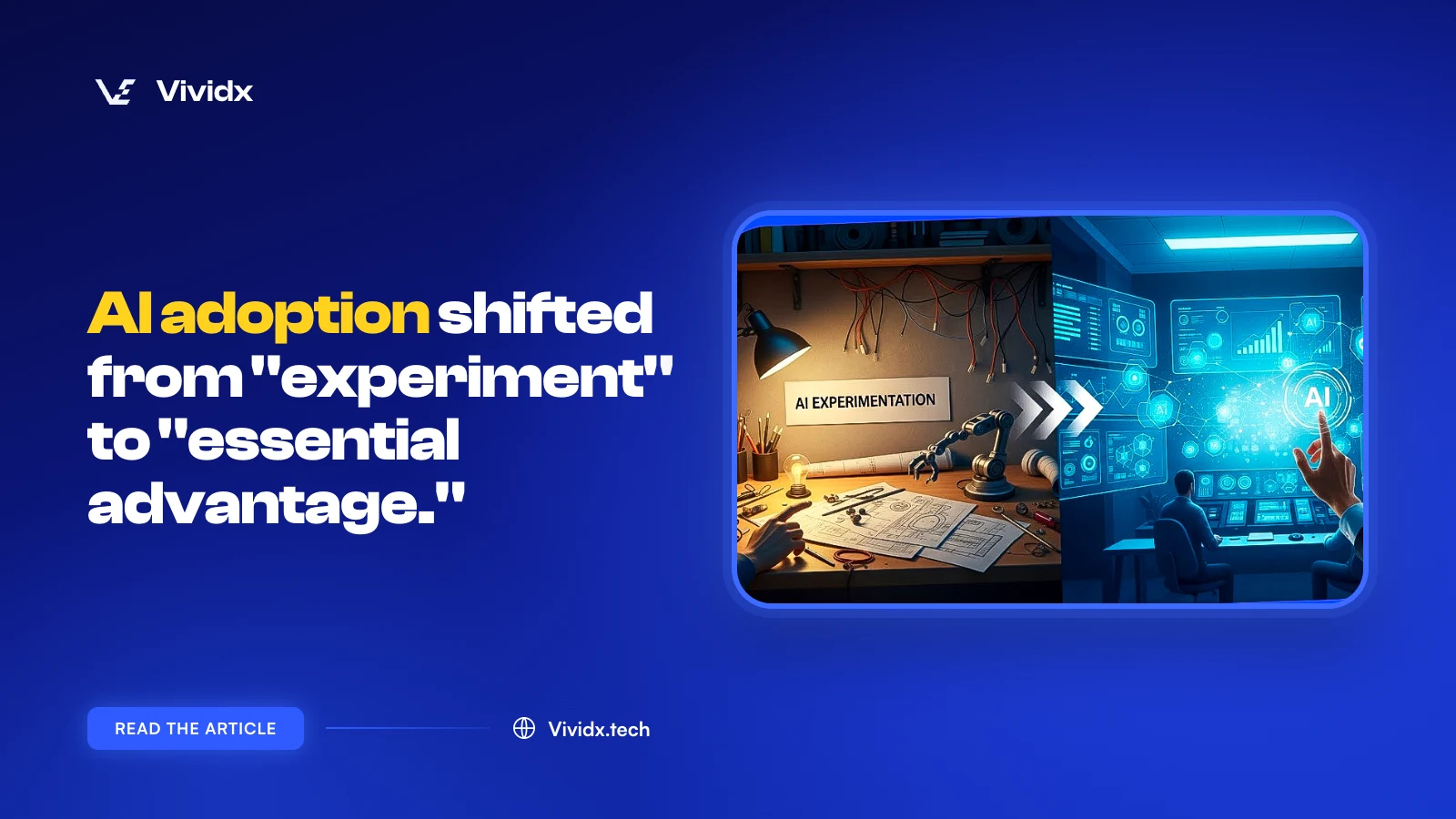
AI Adoption Has Left the Lab. The Question Now Is Whether Your Organization Left With It.
There was a moment not too long ago when having an AI pilot program made you look innovative. You were experimenting. You were forward-thinking. You were ahead of the curve.
That moment is over.
78% of organizations now use AI in at least one business function, up from 55% just two years ago. AI did not just cross the chasm from early adopters to mainstream. It crossed it and kept running. Worker access to AI rose by 50% in 2025 alone. What was once a competitive differentiator has quietly become the baseline expectation.
The organizations that treated AI as an experiment have a problem. The experiment ended. And they are still in the lab.
From Experiment to Essential: What Actually Changed
The shift did not happen because AI suddenly became more capable, though it did. It happened because the organizations leading the market stopped asking whether AI was worth investing in and started asking something harder.
How do we make this actually work?
IBM's workflows study says surveyed executives expected AI-enabled workflows to grow from 3% to 25% by end of 2025, with 64% of AI budgets now spent on core business functions. That is not experimentation language. That is infrastructure language. The best organizations stopped bolting AI onto the edge of their operations and started rebuilding their core workflows around it.
The results are impossible to ignore. 74% of organizations that deployed AI properly achieved ROI within the first year, with 56% reporting direct revenue gains.
But here is the part of the story that does not make the headlines.
Only 6% of organizations qualify as true AI high performers generating meaningful EBIT impact. 42% of companies abandoned most of their AI initiatives in 2025, up sharply from 17% the year before.
Widespread adoption did not mean widespread success. It meant widespread deployment with deeply uneven results. And the gap between the organizations winning with AI and those still cycling through failed initiatives comes down to one thing almost every time.
Not the technology. The foundation underneath it.
Why Most AI Initiatives Still Fail
The 70 to 85% AI project failure rate documented by MIT and RAND Corporation is not a technology problem. Success requires fixing data quality issues, setting clear objectives before deployment, building organizational capabilities alongside technology, and implementing strong governance.
Read that again. Data quality. Clear objectives. Organizational capability. Governance.
None of those are AI problems. They are data problems. And organizations that skipped building the right data foundation before deploying AI are discovering that intelligence layered on top of poor infrastructure does not produce intelligence. It produces confident errors at scale.
47% of enterprise AI users made at least one major business decision based on hallucinated content in 2024. Not because the AI was poorly chosen. Because the data environment it was operating in was not built to catch what the AI could not know it was getting wrong.
This is the hidden cost of treating AI adoption as a technology decision rather than a data strategy decision.
The Organizations Pulling Away
The ones winning right now share a specific pattern. They did not start with AI. They started with their data.
They built clean, governed, well-structured data infrastructure first. They established clear data literacy across leadership so that when AI surfaced an insight, the people receiving it knew how to evaluate, trust, and act on it. They defined what outcomes they were optimizing for before they touched a model. And they built human oversight into every layer of deployment so that speed never came at the cost of accuracy.
Enterprises where senior leadership actively shapes AI governance achieve significantly greater business value than those delegating the work to technical teams alone.
That is the differentiator. Not the model. Not the vendor. The organizational infrastructure built around it.
Only one third of companies have moved beyond experimentation or pilot projects to scale AI across the enterprise. The other two thirds are not failing because they lack ambition. They are failing because they deployed innovation on an unstable foundation and are now discovering what that costs.
What the Next Phase Demands
The market for AI agents is expected to grow to $52.6 billion by 2030, with a remarkable 45% compound annual growth rate. By 2028, approximately 15% of work decisions will likely be made autonomously by agentic AI, compared to 0% in 2024.
The next phase of AI adoption is not going to be more forgiving of weak foundations than this one was. It is going to be less forgiving. Autonomous agents making decisions require data that is accurate, governed, and trustworthy at a level most organizations have not yet achieved.
The window to build that foundation is not closing. But it is narrowing.
Where Vividx Comes In
At Vividx we work with data teams and technology organizations at exactly this inflection point. The moment where the pressure to deploy AI is real but the foundation underneath it is not yet ready to support what that deployment actually demands.
We help organizations build the data infrastructure, governance frameworks, and organizational intelligence that turn AI from an expensive experiment into a compounding competitive advantage.
Not by selling you another tool. By building the environment where the tools you already have finally work the way they were supposed to.
Because the organizations that will define the next decade of their industries are not the ones that adopted AI earliest.
They are the ones that built it on something solid.
Published by Vivid Explorer | vividx.tech