



Data-Driven Teams vs Opinion-Driven Teams: Why Evidence Outperforms Instinct
Teams that rely on opinions gamble with uncertainty; teams that rely on data build with precision. The difference is not stylistic but strategic — one drives inconsistency, the other drives measurable growth. In a world where advantage depends on clarity and evidence, data-driven teams don’t just make better choices — they secure the future of the business.“Data beats gut feelings — every time. Opinions may influence decisions, but only data secures progress.”
Every organization wrestles with a fundamental divide: some teams build decisions on evidence, while others rely on opinion. At first glance, opinion-driven teams may appear confident and decisive, but beneath the surface their choices are fragile, inconsistent, and vulnerable to bias.
Data-driven teams, by contrast, operate with clarity, alignment, and measurable outcomes. This distinction is more than a working style — it determines whether a business grows with precision or drifts with uncertainty.
The Cost of Opinion-Driven Teams
Opinion-driven teams may have good intentions, but their decision-making often exposes structural weaknesses:
- Subjectivity rules → Choices reflect personal bias instead of verifiable facts.
- Hierarchy dominates → The loudest voice or highest rank overrides evidence.
- Short-term unpredictability → Wins happen by chance, not by design.
- Inflexibility → Gut feelings resist change, slowing adaptation when markets shift.
Operating on instinct may feel natural, but in volatile environments, it is a costly gamble.
The Advantage of Data-Driven Teams
Evidence-based teams approach decisions differently. By replacing speculation with insight, they unlock strategic benefits:
- Clarity over confusion → Facts establish direction without debate.
- Faster insight cycles → Problems and opportunities surface quickly.
- Shared accountability → Teams align around the same numbers, not competing narratives.
- Consistent innovation → Evidence encourages experimentation backed by validation.
- Trustworthy performance metrics → Progress is measured and replicable.
Such teams don’t just make better choices — they create a foundation for resilience and long-term growth.
Evidence in Action: Industry Comparisons
The difference between opinion and data-driven cultures becomes clear across industries:
- Retail → Evidence-based teams optimize stock levels through predictive demand; opinion-driven teams risk shortages or overstocking.
- Healthcare → Hospitals using analytics cut waiting times and improve outcomes; those relying on assumptions stagnate.
- Finance → Data-led banks detect fraud instantly; opinion-led banks overlook critical risks.
- Marketing → Campaigns designed with insight deliver measurable ROI; guesswork burns time and budgets.
Across sectors, the conclusion is consistent: evidence outperforms instinct.
Building a Data-Driven Team: A Strategic Blueprint
Shifting from opinion to evidence requires cultural and operational redesign. The essential steps include:
- Leadership as role models → Executives must embody data-backed decision-making.
- Accessible, reliable data → Teams need consistent, trusted sources of insight.
- Data literacy programs → Equip employees to interpret and apply insights effectively.
- Seamless integration → Analytics tools must be part of everyday workflows.
- Cultural reinforcement → Reward individuals and teams that act on evidence.
This approach transforms data from a departmental tool into an organizational discipline.
Beyond Opinions: Securing the Advantage
Opinions will always spark ideas — creativity often begins with intuition. But without evidence to validate and scale those ideas, they remain risky guesses.
The organizations that endure and excel are those that replace instinct-driven authority with evidence-driven clarity.
Similar publication
 AI in Real Life: Turning Prediction into Progress
Predictive intelligence is only powerful when it drives action. AI forecasts mean nothing if they don’t change behavior. At Vividx,…
Read More Beyond the Creative: The Blueprint for a High-Performance, Data-First Marketing Team
Is your marketing team fueled by intuition or intelligence? In 2026, the gap between creative brilliance and market dominance is…
Read More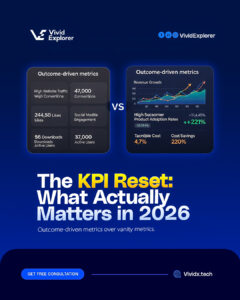 The KPI Reset: Why Your "Success Metrics" Might Be Lying to You in 2026
Is your data telling you the truth, or just what you want to hear? In 2026, many businesses are "rich"…
Read More The Death of the Dashboard: Why 2026 is the Year of Embedded Intelligence
Make Data Invisible, But Omnipresent The most powerful technology is the kind you don't even notice because it’s working for…
Read More