


Predictive Nudges: When to Ask the Machine for Advice
Predictive nudges are transforming business intelligence by blending machine precision with human judgment. Rather than replacing human decision-makers, they empower them to act with greater clarity and confidence. This balance of prediction and intuition builds trust, reduces risk, and creates a smarter, more adaptive organization ready for the future.In modern organizations, decision-making has evolved far beyond instinct. Every choice, from marketing campaigns to customer engagement, is now influenced by data, models, and machine intelligence. Yet amid this evolution, one truth remains unchanged: the best decisions still rely on human judgment.
At VividX, we call this balance the science of the nudge — using predictive systems to guide action, not to control it. It is the art of letting machines advise while humans decide. When done right, this partnership between human intuition and data-driven intelligence does more than optimize performance. It transforms how organizations think, act, and grow.
The Power of Predictive Nudges
A predictive nudge is not an instruction. It is a suggestion powered by insight — a machine-generated whisper that says, “Here’s what might happen, and here’s what you could do next.”
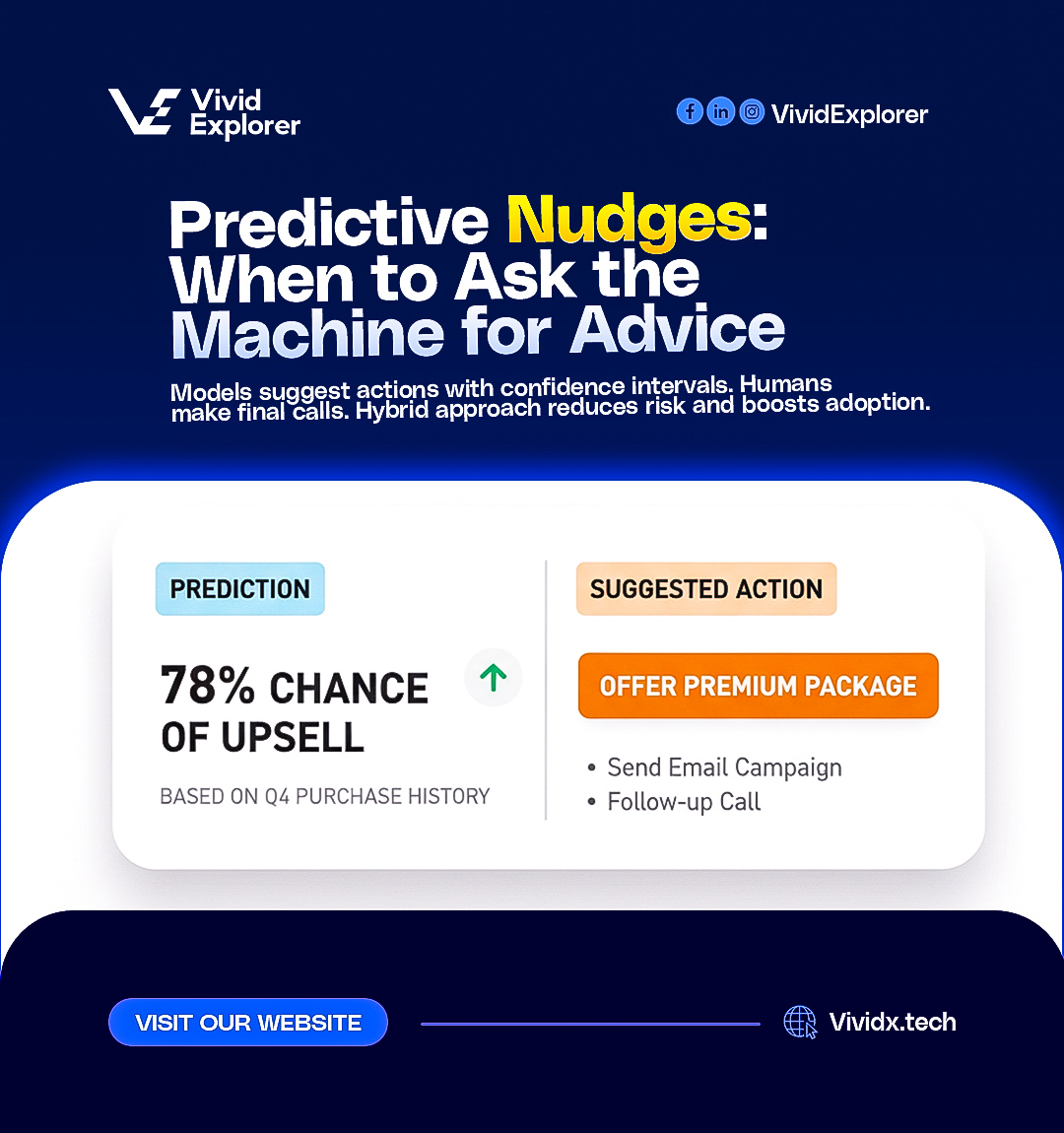
Think of it as a digital advisor that observes, analyzes, and anticipates outcomes with precision. For example, imagine your analytics system predicts a 78 percent chance of customer upsell based on Q4 purchase patterns. It then suggests:
Action: Offer a premium package, initiate an email campaign, or schedule a follow-up call.
That is a predictive nudge — a data-backed recommendation that gives your team the context to act swiftly and confidently. It does not replace their expertise. It amplifies it.
Predictive nudges are powerful because they bridge the gap between complex analytics and human understanding. Instead of overwhelming decision-makers with raw data, they present clear insights that can be interpreted and executed in seconds.
Where Machines Shine and Where Humans Must Lead
Predictive models are excellent at identifying patterns. They can scan through thousands of variables, detect subtle shifts, and forecast probabilities with impressive accuracy. But what they cannot do is understand context, empathy, or long-term implications.
For instance, a model might predict that lowering prices could increase customer conversion by 20 percent. But it does not consider brand perception, market positioning, or the emotional experience of your audience. That is where human intuition steps in.
The hybrid approach, where machines predict and humans interpret, is where real transformation happens. Organizations that embrace this model reduce operational risks, improve trust in AI, and see greater adoption of intelligent systems across teams.
At VividX, we have observed that companies combining predictive models with strong human oversight do not just make faster decisions; they make better ones. They understand that data is a compass, not a captain.
Turning Predictions into Action
The real challenge is not generating predictions; it is turning them into clear, actionable steps. A truly effective predictive system should communicate three things at a glance:
- What is happening
- Why it is happening
- What should you do next
This is where dashboard design and user experience intersect with analytics. A well-designed interface translates complex data into clarity. It highlights the confidence interval, the suggested action, and the potential impact.
For example, rather than displaying endless metrics, your dashboard might show a simple alert:
Prediction: 78 percent chance of upsell
Suggested Action: Offer premium package
Context: Based on Q4 purchase history
When presented this way, insights become intuitive, fast, and empowering. Teams can act immediately — not because they were told to, but because they understand why.
Building Trust in Machine Collaboration
For many organizations, hesitation to rely on predictive models often comes from a lack of transparency. Leaders ask, “Can we really trust the machine?”
The answer lies in how you present and use those predictions. When models are built with interpretability in mind — when their logic is explainable and their suggestions traceable — trust grows naturally. Predictive nudges that include context, reasoning, and confidence levels reduce fear and resistance.
Over time, employees stop seeing AI as a replacement and start seeing it as a reliable partner. They begin to rely on predictive tools not because they have to, but because they want to. That shift in mindset is where cultural transformation begins.
The Future of Predictive Decision-Making
We are entering an era where decision-making will no longer be reactive but anticipatory. Predictive nudges will not only inform what is happening now but also shape what happens next.
Imagine systems that detect customer dissatisfaction before complaints arise, or models that forecast inventory shortages weeks in advance. The possibilities are endless when data becomes proactive instead of passive.
But even as predictive intelligence becomes more sophisticated, human oversight remains essential. Machines can detect what is likely, but only humans can define what is right. Data might suggest an opportunity, but strategy determines whether it aligns with the brand’s mission, ethics, and long-term goals.
This is where the real magic happens — in the collaboration between data-driven prediction and human purpose.
In Summary
Predictive nudges are not about surrendering control to machines. They are about amplifying human capacity through insight. They turn analytics from noise into narrative — a story that helps leaders move from uncertainty to clarity.
When organizations learn to listen to the machine at the right moments, they unlock the ability to act faster, smarter, and more strategically. The key is not to let the algorithm decide, but to let it advise.
The future of intelligent decision-making belongs to those who master this balance — organizations where prediction informs purpose, and humans remain at the center of every decision.
Similar publication
 AI in Real Life: Turning Prediction into Progress
Predictive intelligence is only powerful when it drives action. AI forecasts mean nothing if they don’t change behavior. At Vividx,…
Read More Beyond the Creative: The Blueprint for a High-Performance, Data-First Marketing Team
Is your marketing team fueled by intuition or intelligence? In 2026, the gap between creative brilliance and market dominance is…
Read More The KPI Reset: Why Your "Success Metrics" Might Be Lying to You in 2026
Is your data telling you the truth, or just what you want to hear? In 2026, many businesses are "rich"…
Read More The Death of the Dashboard: Why 2026 is the Year of Embedded Intelligence
Make Data Invisible, But Omnipresent The most powerful technology is the kind you don't even notice because it’s working for…
Read More