


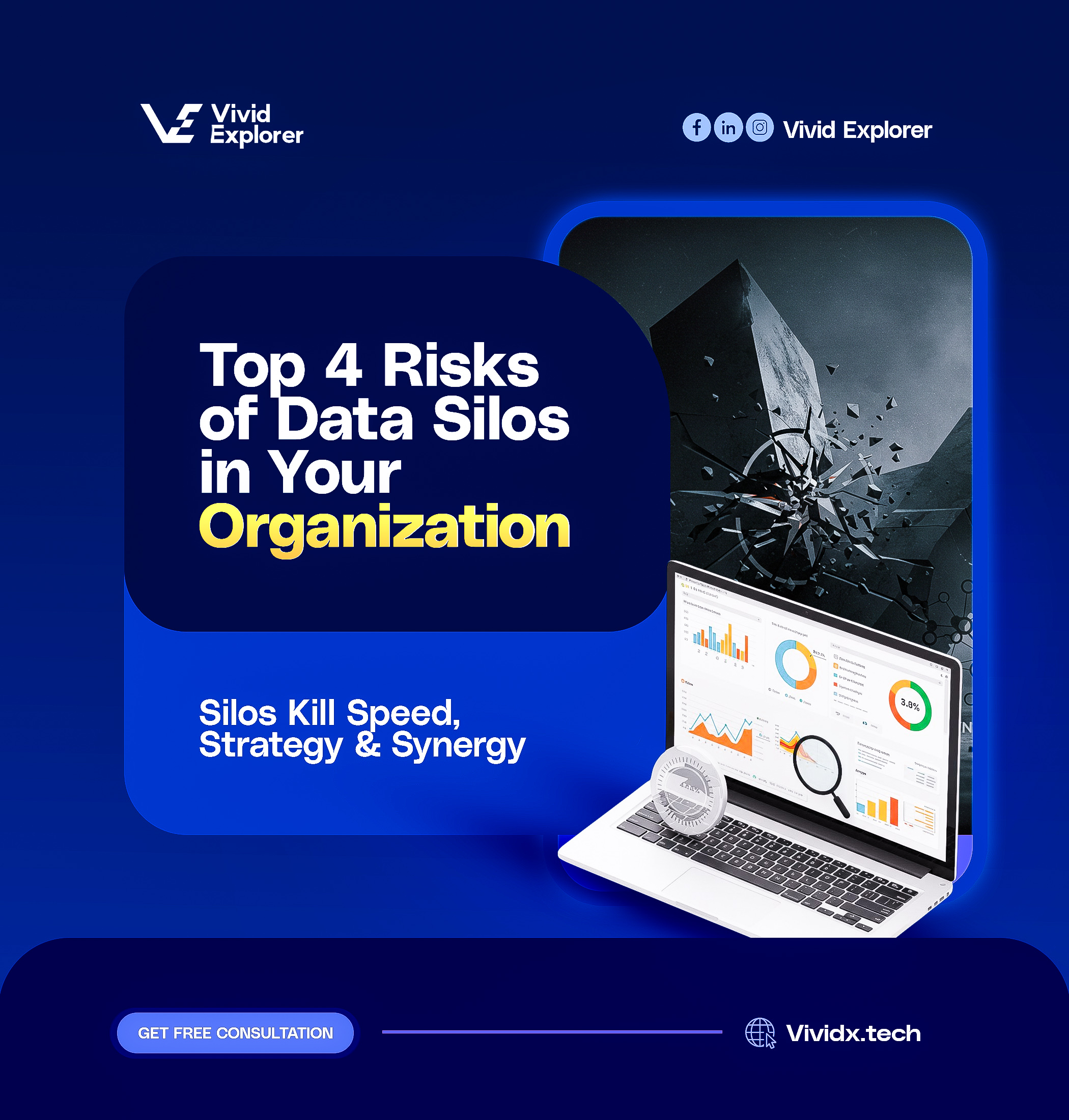
Top 4 Risks of Data Silos in Your Organization
Behind every slow decision, fractured team, and missed opportunity, there’s often one silent culprit—data silos. This article uncovers the hidden risks they pose to organizational speed, strategy, and security, and why dismantling them isn’t optional for leaders who want to build agile, intelligent, and future-ready enterprises.When Insight Is Isolated, So Is Growth
Data is no longer just a byproduct of business—it's the foundation of competitive advantage. But what happens when that data, no matter how vast or valuable, is scattered across disconnected departments and platforms? You end up with something far more dangerous than inefficiency—you create data silos.
And while they may not seem urgent on the surface, data silos are silent growth killers. They fragment your insights, distort your decision-making, and cripple collaboration—causing lasting harm to both operational integrity and customer trust.
In this article, we’re going beyond surface-level definitions to uncover the deep, strategic risks data silos pose—and why dismantling them should be a top leadership priority.
1. Strategic Blindness
When data doesn’t connect, vision fails.
Decision-making in modern organizations is only as sharp as the data behind it. Siloed data presents an illusion of knowledge—it looks complete, but in reality, it’s fragmented. Leaders end up charting paths using maps with missing regions, making strategic calls on skewed information.
What it leads to:
- Misdirected investments
- Flawed forecasting
- Weak alignment between teams
- Erosion of trust in reports and dashboards
2. Operational Bottlenecks
Disconnected data slows everything down.
When employees waste hours hunting down data or duplicating what’s already been done elsewhere, the organization bleeds time and efficiency. Silos introduce friction into every workflow—especially when systems, teams, or departments can’t communicate.
What it leads to:
- Workflow redundancies
- Slow project delivery
- Increased cost per task
- Internal frustration and burnout
3. Broken Customer Experience
Customers feel your silos—every time.
Customers don’t see departments. They experience one brand. But when your internal systems don’t sync, the customer journey becomes clumsy. Repeating information, receiving irrelevant offers, or facing delayed responses all signal a fragmented backend.
What it leads to:
- Poor first impressions
- Low personalization
- Declining loyalty
- Lost revenue opportunities
4. Security and Compliance Fragility
Scattered data means scattered protection.
With data spread across multiple uncoordinated systems, enforcing consistent security measures becomes almost impossible. The more your data landscape is fragmented, the harder it is to govern—and the easier it becomes for vulnerabilities to emerge.
What it leads to:
- Increased breach exposure
- Inconsistent compliance with data laws
- Audit failures
- Legal, financial, and reputational risk
A Culture Shift Is the Real Solution
Technology can help unify data—but the real fix is cultural. Organizations must foster an environment where insights are shared, not guarded; where platforms speak to each other by design, not exception. When you remove the invisible walls, you unlock new dimensions of clarity, speed, and growth.
The best-performing organizations aren’t just data-rich—they’re data-fluid. And that starts with recognizing that breaking down silos is not a technical task—it’s a leadership decision.
Excerpt (for SEO & LinkedIn Preview)
Data silos are more than internal obstacles—they're hidden threats to vision, efficiency, and trust. This article explores the four major risks they pose and how forward-thinking organizations can break through these barriers to unlock clarity and scale.
Similar publication
 AI in Real Life: Turning Prediction into Progress
Predictive intelligence is only powerful when it drives action. AI forecasts mean nothing if they don’t change behavior. At Vividx,…
Read More Beyond the Creative: The Blueprint for a High-Performance, Data-First Marketing Team
Is your marketing team fueled by intuition or intelligence? In 2026, the gap between creative brilliance and market dominance is…
Read More The KPI Reset: Why Your "Success Metrics" Might Be Lying to You in 2026
Is your data telling you the truth, or just what you want to hear? In 2026, many businesses are "rich"…
Read More The Death of the Dashboard: Why 2026 is the Year of Embedded Intelligence
Make Data Invisible, But Omnipresent The most powerful technology is the kind you don't even notice because it’s working for…
Read More