


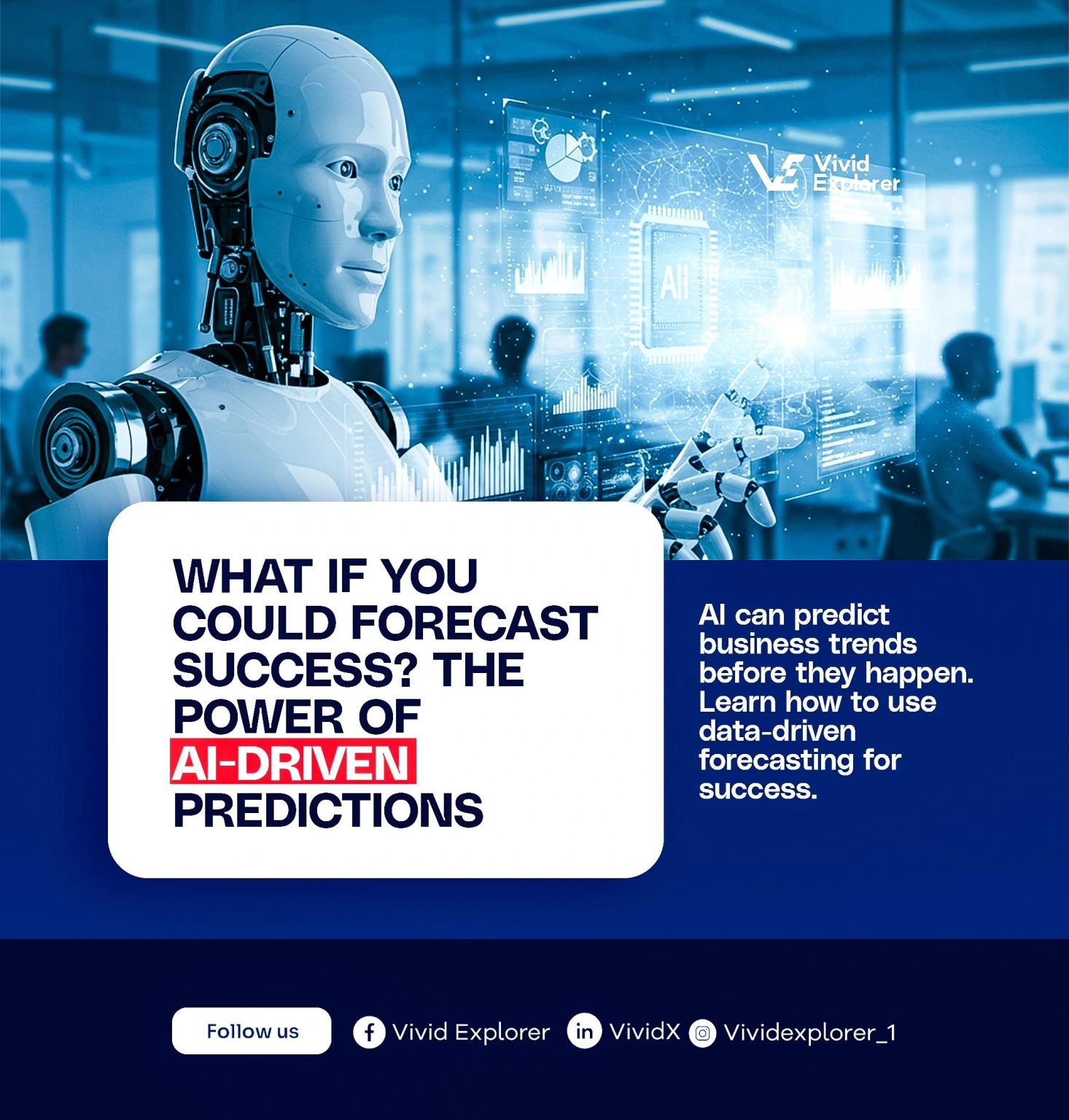
PREDICTING TOMORROW: HOW AI FORECASTING IS REDEFINING MODERN BUSINESS STRATEGY
Partner with Vivid Explorer for AI Forecasting Solutions At Vivid Explorer, we help businesses tap into the power of AI forecasting to improve planning, performance, and profitability. Whether you're just starting out or looking to integrate advanced predictive systems, we offer the tools and expertise to support your transformation.Imagine knowing what your customers will want before they do. Picture making business decisions not based on guesswork, but on intelligent predictions powered by data. This is not a vision of the future it is the reality of today, made possible through AI-driven forecasting.
Artificial Intelligence (AI) has moved beyond buzzwords and experimental labs. It is now a critical tool in the hands of forward-thinking organizations that want to stay ahead of the curve. From retail giants to tech startups, businesses are leveraging AI to predict trends, optimize operations, and create sustainable growth.
Understanding AI-Driven Forecasting
AI-driven forecasting uses machine learning algorithms and statistical models to analyze historical and real-time data, enabling businesses to make more accurate predictions about future outcomes. Unlike traditional forecasting, which relies on static models and past performance alone, AI systems continuously learn, adapt, and improve over time.
These models can detect complex patterns, relationships, and anomalies that humans often miss. They provide actionable insights in areas like customer behavior, inventory demand, market trends, supply chain logistics, financial performance, and more.
How It Works
The process behind AI-driven forecasting typically involves several key steps:
1. Data Collection and Integration
AI pulls data from various sources sales records, social media, website analytics, CRM systems, weather forecasts, economic indicators, and more.
2. Pattern Recognition
Using algorithms such as neural networks and decision trees, the system identifies trends and correlations that influence future events.
3. Prediction Generation
AI models generate forecasts based on current and historical data, often presenting them with a probability score or confidence interval.
4. Continuous Learning
The system refines its accuracy over time by learning from new inputs, creating more precise and reliable forecasts.
Why AI Forecasting Is a Game-Changer for Businesses
Traditional forecasting methods often fall short in today’s dynamic business environment. Consumer behavior shifts rapidly, global events disrupt supply chains, and digital trends evolve overnight. AI forecasting offers a distinct competitive advantage by enabling organizations to respond quickly and strategically.
Key Benefits of AI Forecasting
1. Increased Accuracy
AI can process massive datasets and recognize non-linear relationships, significantly reducing human error and bias.
2. Real-Time Insights
Forecasts can be generated and updated in real-time, allowing businesses to make timely decisions rather than relying on outdated reports.
3. Improved Efficiency
From optimizing inventory levels to automating demand planning, AI helps reduce waste, save time, and lower operational costs.
4. Risk Mitigation
By identifying potential risks and disruptions early, companies can take preemptive action and avoid costly mistakes.
5. Strategic Growth
AI forecasting supports smarter decision-making, whether you're launching a new product, entering a new market, or scaling your operations.
Industry Applications
AI-driven predictions are reshaping operations across industries:
Retail
Forecast consumer demand, reduce stockouts, personalize marketing, and manage seasonal inventory effectively.
Finance
Predict market movements, assess credit risk, identify fraud patterns, and optimize investment strategies.
Healthcare
Forecast patient needs, manage resource allocation, and predict disease outbreaks for better public health planning.
Logistics and Supply Chain
Predict delivery times, plan routes efficiently, manage warehousing, and respond to external disruptions faster.
Real Estate and Construction
Forecast property value trends, estimate project timelines, and analyze market demand in specific locations.
Real-World Examples
Netflix
Uses AI to analyze viewer preferences and predict what shows or movies will be popular, shaping content creation and personalized recommendations.
Walmart
Leverages AI forecasting to manage its supply chain. During hurricanes, its systems predict increased demand for specific items like bottled water and breakfast foods, ensuring stores are stocked in advance.
Amazon
Combines AI with predictive analytics to manage fulfillment centers and anticipate delivery logistics, maintaining customer satisfaction at scale.
Implementing AI Forecasting in Your Business
You don’t need to be a tech giant to start benefiting from AI. Here’s a practical roadmap for implementation:
Step 1: Assess Your Data Readiness
Start by identifying the data sources available to you. Even small datasets can be useful for initial forecasting models.
Step 2: Define Clear Objectives
Determine what you want to predict whether it's customer churn, product demand, delivery times, or revenue.
Step 3: Choose the Right Tools
There are many AI platforms that offer pre-built models or no-code environments, such as Google AutoML, IBM Watson, Microsoft Azure ML, and industry-specific tools.
Step 4: Start Small and Scale Up
Begin with a single use case and refine your model based on feedback and performance. Once successful, expand the application across departments.
Step 5: Train Your Team
Ensure your staff understands how to interpret AI-generated forecasts and use them in decision-making processes.
The Future of Predictive Intelligence
As technology evolves, so will AI forecasting capabilities. Some of the emerging trends include:
- Explainable AI (XAI): AI systems that can explain the rationale behind their predictions, increasing transparency and trust.
- Generative AI for Forecasting: Models that not only predict what’s likely to happen, but suggest optimal responses or alternatives.
- Edge AI Forecasting: Forecasts running directly on devices (like sensors or mobile apps), enabling immediate insights at the point of action.
In the near future, AI forecasting won’t just be an advantage—it will be a necessity for businesses that want to remain competitive in a fast-paced digital world.
Partner with Vivid Explorer for AI Forecasting Solutions
At Vivid Explorer, we help businesses tap into the power of AI forecasting to improve planning, performance, and profitability. Whether you're just starting out or looking to integrate advanced predictive systems, we offer the tools and expertise to support your transformation.
Our Services Include:
- AI forecasting strategy development
- Predictive model design and integration
- Business intelligence dashboards
- AI training and capacity building
If you’re ready to make smarter decisions, reduce uncertainty, and move with confidence, AI forecasting is your next strategic move.
Similar publication
 AI in Real Life: Turning Prediction into Progress
Predictive intelligence is only powerful when it drives action. AI forecasts mean nothing if they don’t change behavior. At Vividx,…
Read More Beyond the Creative: The Blueprint for a High-Performance, Data-First Marketing Team
Is your marketing team fueled by intuition or intelligence? In 2026, the gap between creative brilliance and market dominance is…
Read More The KPI Reset: Why Your "Success Metrics" Might Be Lying to You in 2026
Is your data telling you the truth, or just what you want to hear? In 2026, many businesses are "rich"…
Read More The Death of the Dashboard: Why 2026 is the Year of Embedded Intelligence
Make Data Invisible, But Omnipresent The most powerful technology is the kind you don't even notice because it’s working for…
Read More