


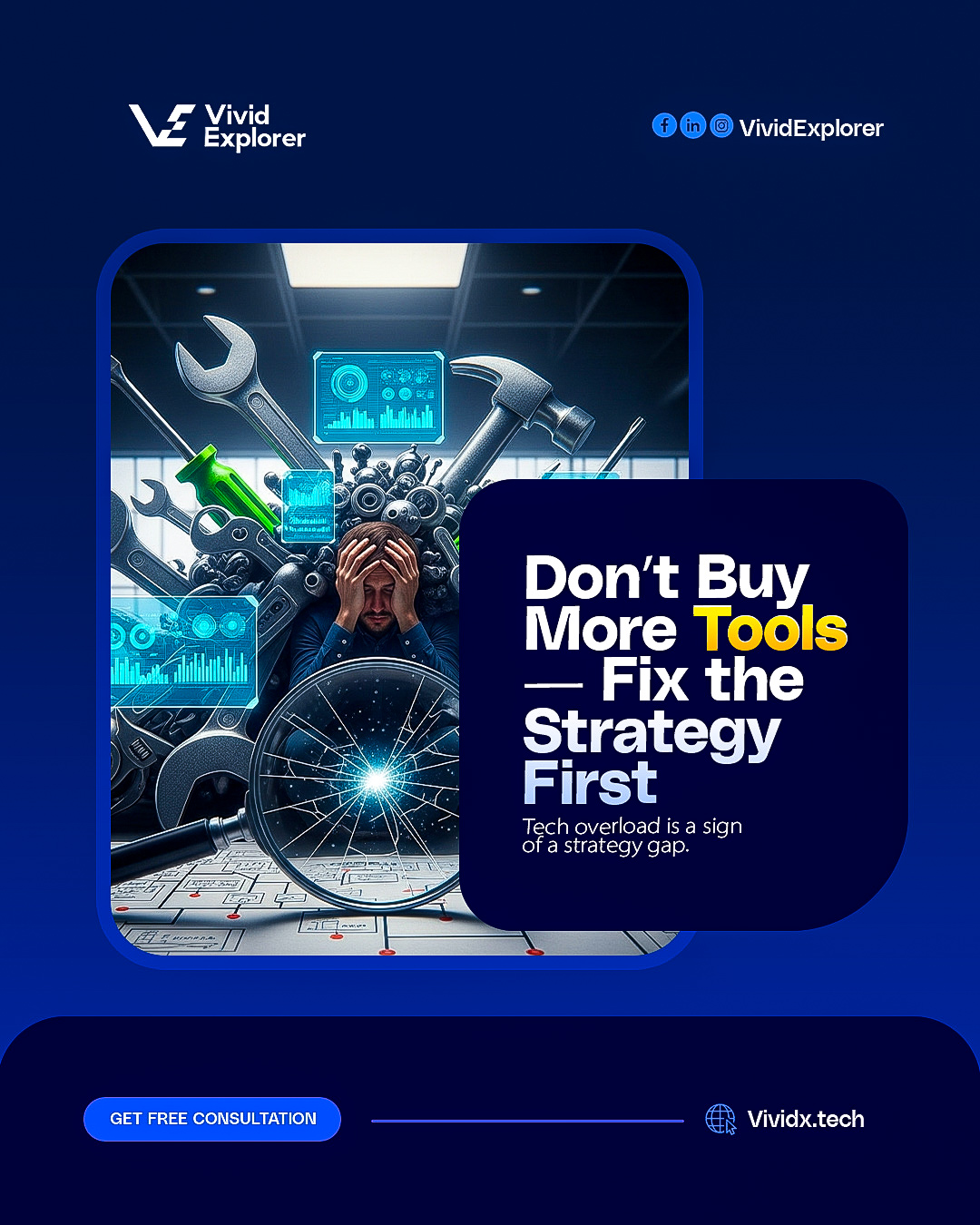
Don't Buy More Tools. Fix the Strategy First.
Technology should make a business simpler, smarter and more responsive. But when every new problem leads to another platform, dashboard or AI tool, complexity can quietly become the cost of transformation. This article explores why technology overload is often a symptom of an unclear strategy, how organizations can evaluate their existing technology stack, and why the most effective digital transformation begins with business priorities rather than technology purchases.Why technology overload is often a business strategy problem, not a technology problem
There is a point in many organizations where the technology stack becomes impressive on paper and exhausting in practice.
A new analytics platform is introduced.
Then an automation tool.
Then an AI assistant.
Then another dashboard.
Then another system to connect everything together.
Each purchase makes sense individually.
But eventually, teams are moving between five different platforms to answer one simple business question.
And leadership starts asking:
“Why do we have all these tools, yet getting a clear answer still takes so long?”
That is usually when the real problem becomes visible.
It was never simply a technology gap.
It was a strategy gap.
Technology cannot compensate for an unclear direction
There is nothing inherently wrong with investing in new technology.
The problem begins when technology becomes the starting point.
A business sees a new AI platform and asks:
“Can we use this?”
A better question is:
“What business problem are we trying to solve, and is this the right way to solve it?”
That distinction can save organizations enormous amounts of time, money and operational complexity.
Because the best technology investment isn't necessarily the most sophisticated one.
It is the one that solves a clearly defined problem and fits into the way the organization actually operates.
The hidden cost of technology overload
Technology overload doesn't always appear as a large expense on a balance sheet.
Sometimes, you see it in the everyday work.
Employees entering the same information into multiple systems.
Analysts manually combining data from different platforms.
Managers receiving conflicting versions of the same metric.
Teams paying for features they rarely use.
Employees spending more time learning tools than using them to solve business problems.
And perhaps most importantly, decisions taking longer because information is scattered across too many places.
The organization has digitized its processes without necessarily simplifying them.
That is an expensive distinction.
More tools can create more fragmentation
Imagine a company where marketing has one platform, sales has another, customer service has another, finance has another, and operations has another.
Every platform may be excellent.
But if those systems don't work together properly, the organization doesn't have one connected view of the business.
It has islands of information.
That creates questions such as:
Which number is correct?
Why doesn't this report match that dashboard?
Who owns this data?
When was this information updated?
Can we trust this metric?
These aren't technology questions anymore.
They are questions of strategy, governance and operating design.
Start with the business, then choose the technology
A stronger approach begins with the organization's priorities.
Perhaps the objective is to reduce customer churn.
Perhaps it is to improve forecasting.
Perhaps the business wants to reduce reporting time.
Perhaps leadership needs greater visibility across operations.
Perhaps the organization wants to introduce AI into existing workflows.
Once the objective is clear, the technology conversation becomes much more productive.
You can determine:
What information is required?
What systems already contain it?
Where are the gaps?
Which processes should be automated?
What should remain human-led?
What technology is actually necessary?
And how will success be measured?
Now you're not buying technology because it is available.
You're designing technology around a business outcome.
Before adding another tool, ask five questions
Before introducing another platform into your organization, pause and ask:
1. What specific problem will this solve?
If the answer is vague, the investment probably needs more thought.
2. Do we already have a tool that can solve it?
Many organizations purchase capabilities they already own but haven't fully implemented.
3. How will this fit into our existing workflow?
A powerful tool that creates another disconnected process may create more problems than it solves.
4. Who will actually use it?
Adoption matters as much as functionality.
5. How will we know it worked?
If there is no measurable outcome, it becomes difficult to distinguish transformation from technology spending.
These questions sound basic.
They aren't.
They force the organization to think beyond the excitement of the new tool.
The objective isn't to have a modern technology stack
A modern business isn't necessarily the one with the most software.
It is the one where technology makes the business easier to understand, easier to operate and easier to improve.
Sometimes that means introducing new technology.
Sometimes it means integrating systems that already exist.
Sometimes it means automating a process.
Sometimes it means removing three tools and simplifying the workflow.
And sometimes, the smartest technology decision is to buy nothing at all.
That last one can be surprisingly difficult for organizations to accept.
But transformation isn't measured by how much technology you introduce.
It is measured by what becomes better because of it.
Strategy should determine the stack
This is the mindset organizations need as AI, analytics and automation continue to evolve.
Don't begin with:
“What can this technology do?”
Begin with:
“What does our business need to do better?”
Then determine whether technology can help.
That approach creates a much healthier relationship between strategy and technology.
Your tools should support your operating model.
Your data should support your decisions.
Your automation should support your people.
And your technology investments should ultimately support measurable business outcomes.
At VividX, we help organizations take that step back, understand where technology is creating value and where complexity is getting in the way, then build data and technology strategies around what the business actually needs.
Because sometimes the next step forward isn't another tool.
It's a better strategy.
Similar publication
 Why Leaders Must Become Data Storytellers
Data can tell a leader what is happening. But leadership requires something more: understanding why it matters, what could happen…
Read More Data Clarity Isn’t Magic. It’s Method.
Your business may not need more data. It may need a better way to make sense of the data it…
Read More Business Speed Increased. Manual Processes Didn't Survive.
Manual processes do not announce their inefficiency. They just quietly consume the time, attention, and accuracy your business needs to…
Read More AI adoption shifted from "experiment" to "essential advantage."
78% of organizations now use AI in at least one business function. The experiment is over. The question is no…
Read More