


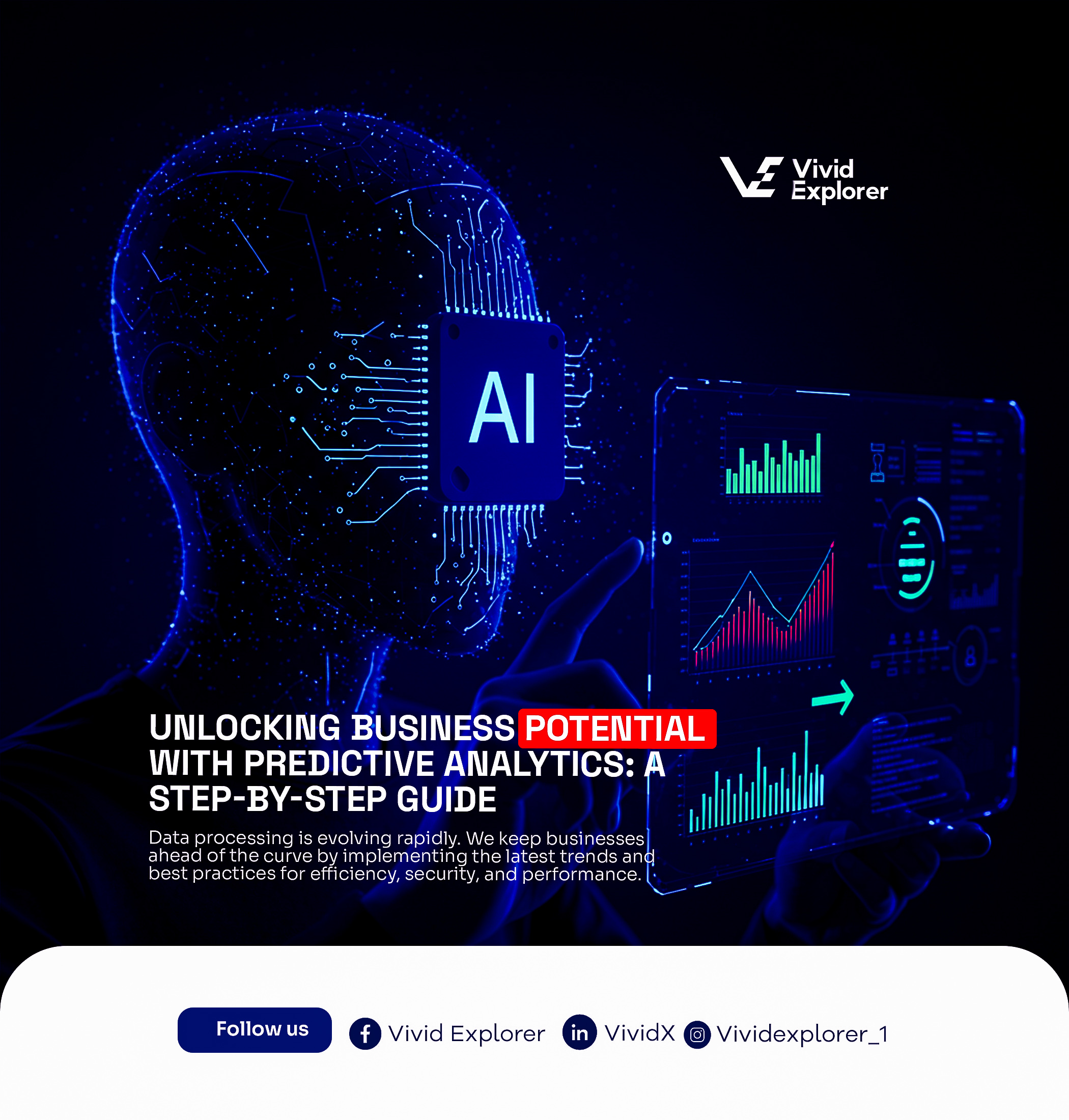
Unlocking Business Potential with Predictive Analytics: A Step-by-Step Guide
Predictive analytics is redefining how modern businesses make decisions. Instead of relying on past data alone, organizations can now anticipate trends, identify risks early, and act with greater confidence. By combining the right data, strategy, and systems, businesses move from reactive reporting to forward-looking insight, unlocking smarter growth, improved efficiency, and a stronger competitive edge.Data has evolved far beyond reporting what has already happened.
Today, the real advantage lies in understanding what is likely to happen next, and preparing for it before it unfolds.
This is where predictive analytics becomes a powerful driver of business performance.
Organizations that embrace it are no longer reacting to outcomes.
They are anticipating them, shaping them, and in many cases, outperforming competitors who are still operating on hindsight.
Why Predictive Analytics Matters Now More Than Ever
In a fast-moving business environment, relying solely on historical data creates a gap between insight and action.
By the time trends are visible in traditional reports, opportunities may already be lost, and risks may have already materialized.
Predictive analytics closes that gap.
By analyzing patterns, behaviors, and historical data, it enables businesses to:
- Forecast future demand and market trends
- Identify potential risks before they escalate
- Optimize operations with greater precision
- Personalize customer experiences at scale
This shift from reactive to proactive decision-making is what defines modern, data-driven organizations.
The Common Misconception
Many businesses assume predictive analytics is complex, expensive, or only relevant to large enterprises.
In reality, the challenge is not access to technology.
It is having the right strategy to apply it effectively.
Without a clear framework, predictive models can become disconnected from real business decisions — producing insights that are interesting, but not actionable.
A Step-by-Step Approach to Predictive Analytics
Step 1: Define the Business Objective
Predictive analytics should always begin with a clear question.
What decision are you trying to improve?
It could be forecasting sales, reducing customer churn, optimizing inventory, or improving operational efficiency.
Clarity at this stage ensures that the insights generated will be relevant and valuable.
Step 2: Assess and Prepare Your Data
The accuracy of any predictive model depends on the quality of the data behind it.
This involves:
- Identifying relevant data sources
- Cleaning and standardizing data
- Ensuring consistency across systems
Incomplete or inconsistent data leads to unreliable predictions, which can undermine trust and decision-making.
Step 3: Integrate and Structure Your Data
Data often exists in silos across different tools and departments.
To unlock its full value, it must be integrated into a unified system where relationships between datasets can be understood.
This step transforms fragmented information into a cohesive foundation for analysis.
Step 4: Build and Train Predictive Models
Using advanced analytics and machine learning techniques, models are developed to identify patterns and generate forecasts.
These models are not static.
They evolve as new data becomes available, continuously improving accuracy over time.
Step 5: Translate Insights into Action
Predictions alone do not create value.
The real impact comes from how those predictions are used.
Insights must be presented in a way that is clear, accessible, and directly linked to decision-making processes.
This ensures that teams can act quickly and confidently.
Step 6: Monitor, Refine, and Scale
Predictive analytics is not a one-time implementation.
It requires ongoing monitoring and refinement to remain accurate and relevant.
As the business grows, these systems can be scaled to support more complex decisions and broader operational areas.
The Real Business Impact
When implemented effectively, predictive analytics delivers measurable value:
Improved Decision Speed and Accuracy
Leaders gain forward-looking insight, reducing uncertainty and enabling faster action.
Operational Efficiency
Resources are allocated more effectively based on anticipated needs, not assumptions.
Risk Reduction
Potential issues are identified early, allowing for proactive mitigation.
Revenue Growth
Opportunities are recognized sooner, enabling better positioning in competitive markets.
Where Many Organizations Struggle
Despite its potential, several challenges often limit adoption:
- Poor data quality or incomplete datasets
- Lack of integration across systems
- Overly complex models that are difficult to interpret
- Misalignment between analytics teams and business leaders
These challenges highlight the need for a structured, business-focused approach.
How Vivid Explorer Helps
At Vivid Explorer, predictive analytics is approached with a clear objective:
to make advanced insight practical, accessible, and directly tied to business outcomes.
This includes:
- Evaluating existing data infrastructure
- Designing integrated systems for unified data access
- Building models tailored to specific business needs
- Translating predictions into actionable insights
- Continuously optimizing performance as data evolves
The focus is not just on predicting the future, but on enabling businesses to act on it with confidence.
Final Thought
The future of business is not defined by who has the most data,
but by who understands what their data is telling them, ahead of time.
Predictive analytics provides that advantage.
It transforms uncertainty into foresight,
and foresight into strategic action.
For organizations ready to move beyond reactive decision-making,
it is no longer optional. It is essential.
If your business is ready to anticipate rather than react, it may be time to explore how predictive analytics can reshape your decision-making process.
Similar publication
 2026 Will Reward Agile Data Teams, Not Big Ones
Moving on In 2026, the advantage will no longer belong to businesses with the biggest data teams, but to those…
Read More AI in Real Life: Turning Prediction into Progress
Predictive intelligence is only powerful when it drives action. AI forecasts mean nothing if they don’t change behavior. At Vividx,…
Read More Beyond the Creative: The Blueprint for a High-Performance, Data-First Marketing Team
Is your marketing team fueled by intuition or intelligence? In 2026, the gap between creative brilliance and market dominance is…
Read More The KPI Reset: Why Your "Success Metrics" Might Be Lying to You in 2026
Is your data telling you the truth, or just what you want to hear? In 2026, many businesses are "rich"…
Read More