


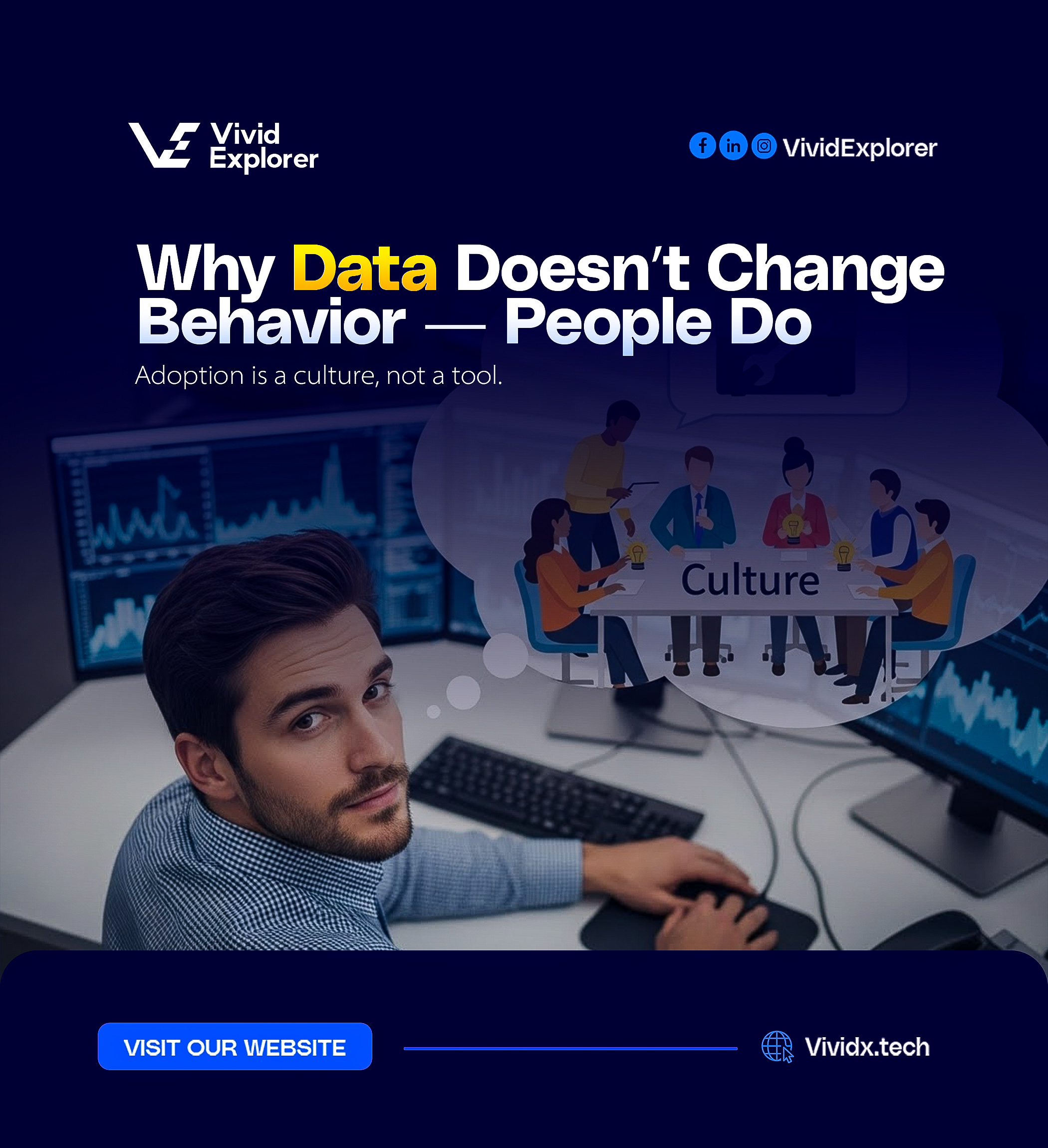
Why Data Doesn’t Change Behavior, People Do
Organizations today are rich in data but often unchanged by it. The gap is not in insight, but in behavior. Until data is trusted, understood, and embedded into how decisions are made, it remains passive. True transformation happens when organizations shift not just their systems, but the way people think, decide, and act.There is a quiet contradiction inside many modern organizations.
They are more informed than ever before
yet not necessarily more decisive.
Dashboards have multiplied.
Data pipelines are more advanced.
Insights are readily available.
And still, the same patterns persist.
The same decisions.
The same delays.
The same outcomes.
It raises an important question:
If the data is right, why doesn’t anything change?
The Assumption That Doesn’t Hold
For years, businesses have operated on a simple belief:
Better data leads to better decisions.
But this assumes that decision-making is purely rational.
That when presented with the right information, people will naturally adjust their actions.
In practice, that rarely happens.
Because decisions are not made in spreadsheets.
They are made in environments shaped by pressure, habit, experience, and organizational dynamics.
Data can inform a decision.
But it cannot override behavior.
Where Data Loses Its Influence
In many organizations, the breakdown does not occur at the level of analytics.
It occurs at the point of interpretation and action.
Insight is produced, but it does not travel.
It becomes:
- A report that is reviewed but not applied
- A dashboard that is checked but not trusted
- A recommendation that is noted but not followed
Over time, this creates a subtle but significant disconnect.
Data exists.
But influence does not.
Behavior Is the Real System
Every organization operates on two systems.
The first is visible: tools, platforms, data infrastructure.
The second is invisible: how decisions are actually made.
This second system is driven by:
- What leaders prioritize
- What teams are rewarded for
- How risk is perceived
- How success is measured
If these elements are not aligned with data, then data remains external to the decision-making process.
It becomes optional.
And what is optional is rarely transformative.
From Access to Adoption
The real challenge is not access to data.
It is adoption of data.
Adoption requires more than availability.
It requires integration into behavior.
For data to influence outcomes, it must:
- Be part of the decision, not an addition to it
- Arrive at the moment it is needed, not after
- Be trusted without hesitation
- Be understood without translation
When these conditions are not met, people default to what is familiar.
Experience.
Instinct.
Past patterns.
Not because they reject data
but because the system around them does not support its use.
The Cultural Shift Most Organizations Miss
Data transformation is often approached as a technical initiative.
New tools are implemented.
Dashboards are redesigned.
Pipelines are optimized.
But behavior remains unchanged.
Because culture was never addressed.
A truly data-driven organization is not defined by what it builds.
It is defined by what it normalizes.
- Decisions that require evidence
- Conversations that begin with data
- Accountability tied to measurable outcomes
This is not enforced through systems alone.
It is reinforced through leadership, repetition, and expectation.
The Role of Leadership in Behavior Change
Behavior follows signals.
And the strongest signals in any organization come from leadership.
When leaders:
- Ask for data before making decisions
- Challenge assumptions with evidence
- Reward outcomes driven by insight
They redefine what “good decision-making” looks like.
Without this, data initiatives operate in isolation.
With it, they become embedded.
How Vivid Explorer Approaches the Problem
At Vivid Explorer, the focus is not limited to building data systems.
It is about ensuring those systems influence real decisions.
That requires a different approach:
- Designing insight around actual decision points
- Structuring data to reduce friction, not add to it
- Delivering clarity instead of complexity
- Aligning systems with how teams already operate — and gradually improving that behavior
Because the objective is not to introduce data into the business.
It is to make data part of how the business thinks.
Data has never been more powerful.
But its impact has never been more misunderstood.
Organizations do not struggle because they lack insight.
They struggle because insight does not consistently translate into action.
And that is not a data problem.
It is a human one.
Because in the end,
data can inform direction — but only people can change it.
Similar publication
 The Future of Data Collection and Its Impact on Business
Data collection is evolving from passive accumulation to intentional design. As real-time systems, distributed architectures, and privacy-first frameworks reshape how…
Read More 5 Signs Your Business Needs a Data Overhaul
Many businesses rely on data daily, yet struggle with delays, inconsistencies, and unclear insights. From slow reporting to disconnected systems,…
Read More The Journey to Data Maturity: 5 Key Stages and How to Navigate Them
The journey to becoming a data-driven organization happens in stages. From reactive reporting to predictive intelligence, each level of data…
Read More The Most Overlooked Skill in Analytics Teams: Why Communication Defines Real Impact
In many analytics teams, the focus is placed on tools, models, and data accuracy, yet one critical element is often…
Read More