


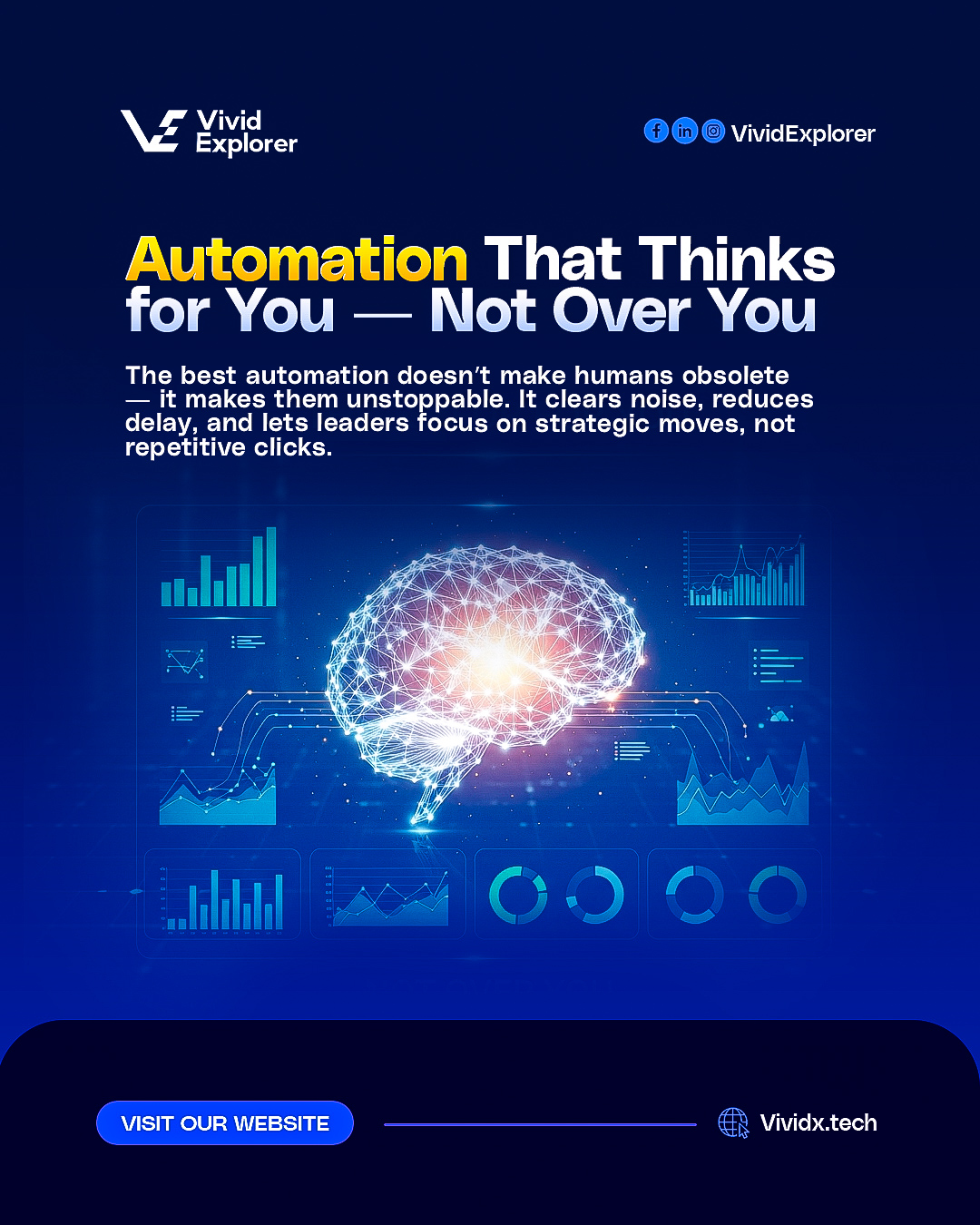
Automation That Thinks for You, Not Over You
Automation was never meant to replace people. It was meant to remove the weight that slows them down. The most effective systems think for you by clearing noise, reducing delays, and preparing the insights leaders need before decisions are made. When automation is aligned with strategy and designed around human judgment, it doesn’t overshadow talent, it amplifies it. Organisations don’t lose the human element. They gain a stronger, sharper, more focused version of it.Build Systems That Amplify, Not Replace
Automation has become one of the most misunderstood concepts in modern business operations. Some leaders see it as a threat to human roles, while others treat it as a miracle fix for operational problems. The truth sits somewhere deeper. Automation is not designed to replace human intelligence. It is designed to free it.
Every organisation has silent drains on performance. Routine reporting that consumes hours. Manual entries that slow down momentum. Approval processes that depend on constant reminders. These tasks accumulate and create operational drag. Automation steps in not to remove people but to remove the weight they carry.
To build automation that truly amplifies human performance, organisations must understand the pillars that make automation effective and empowering.
1. Automation Should Strengthen Human Judgment
Automation becomes powerful when it prepares information ahead of decision-makers.
It should highlight trends, organise insights, and simplify workflows so leaders can make decisions with greater clarity and confidence.
Automation that overshadows human judgment creates resistance.
Automation that supports judgment creates momentum.
2. Automation Should Integrate Into Daily Workflow Naturally
For automation to succeed, it must become part of the organisation’s rhythm.
People adopt what feels intuitive, not what feels imposed.
When automation blends seamlessly into everyday work, teams begin to trust it.
Trust drives usage, and usage drives transformation.
3. Automation Should Reflect Strategy, Not Distract From It
Tools that don’t align with business priorities become noise.
Tools that mirror strategic focus become multipliers.
The most effective automation works in direct partnership with organisational goals.
It clears distractions so leadership energy stays on what matters most.
4. Automation Should Reduce Friction, Not Add Complexity
The true measure of automation is simplicity.
Work should feel lighter.
Tasks should move faster.
Teams should feel less overwhelmed and more in control.
When automation reduces operational friction, it unlocks creativity, innovation, and higher-quality thinking.
5. Automation Should Free People To Do High-Value Work
The greatest benefit of automation is the space it creates for human excellence.
It removes repetitive tasks so teams can focus on strategy, innovation, and problem-solving.
People are not replaced.
They are elevated.
They gain more mental clarity, more strategic freedom, and more room to apply their strengths.
At Vividx, we design automation that becomes a silent force behind organisational excellence. We study how teams think, how decisions move, and where time is being drained. Then we build systems that support people at every level, from frontline execution to executive leadership.
Our goal is simple.
Create automation that thinks for people, not over them.
Automation that removes noise and frees intelligence.
Automation that gives organisations the capacity to operate with speed, clarity, and confidence.
The future of automation is not about replacing humans.
It is about making humans unstoppable.
Similar publication
 Why Leaders Must Become Data Storytellers
Data can tell a leader what is happening. But leadership requires something more: understanding why it matters, what could happen…
Read More Data Clarity Isn’t Magic. It’s Method.
Your business may not need more data. It may need a better way to make sense of the data it…
Read More Business Speed Increased. Manual Processes Didn't Survive.
Manual processes do not announce their inefficiency. They just quietly consume the time, attention, and accuracy your business needs to…
Read More AI adoption shifted from "experiment" to "essential advantage."
78% of organizations now use AI in at least one business function. The experiment is over. The question is no…
Read More