


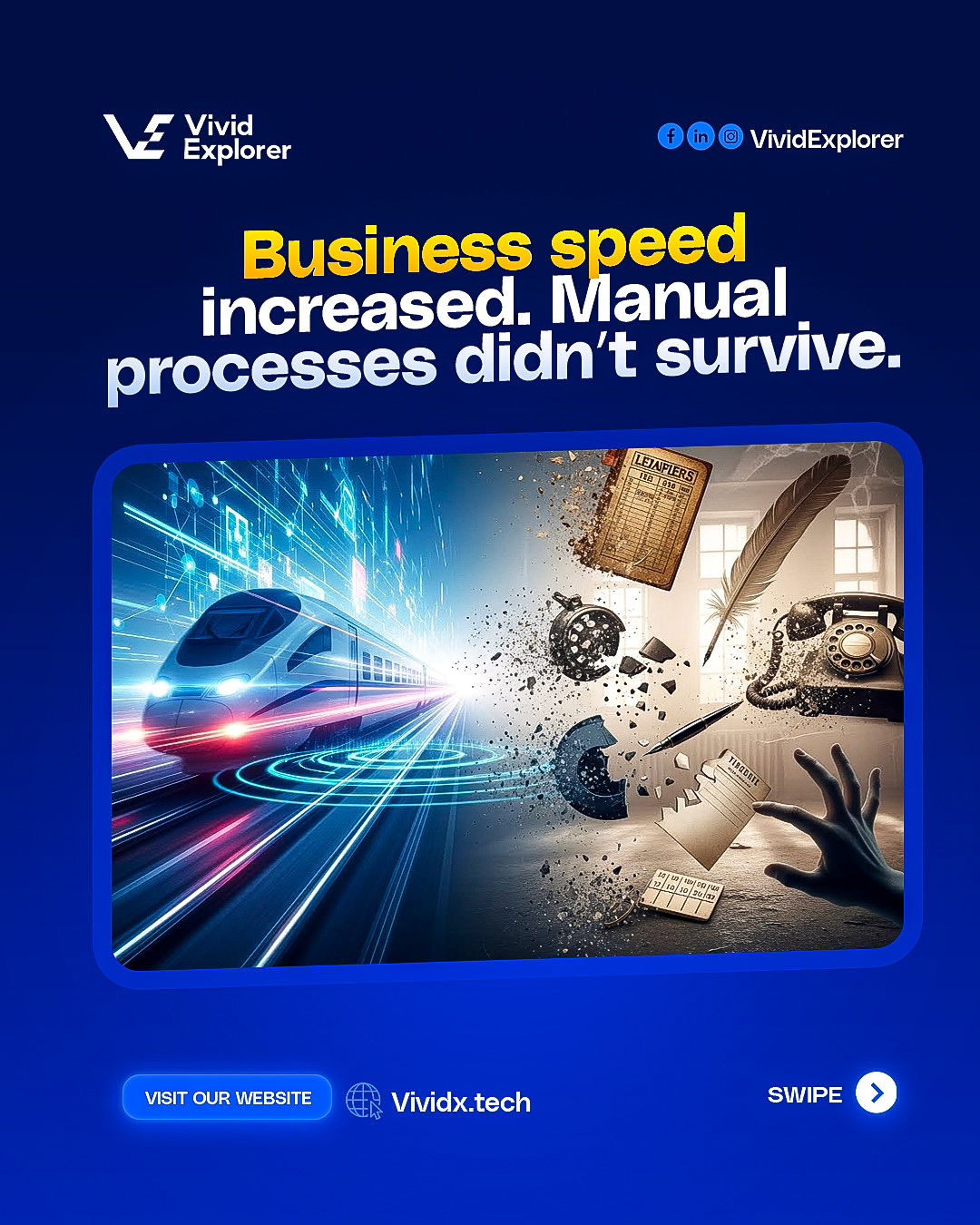
Business Speed Increased. Manual Processes Didn't Survive.
Manual processes do not announce their inefficiency. They just quietly consume the time, attention, and accuracy your business needs to compete. Studies show employees spend 40 to 60% of their working week on tasks that could be fully automated. That is not a productivity problem. That is a structural problem hiding inside your weekly schedule. And in a market moving at this pace, the cost of staying manual is no longer just an operational inconvenience. It is a strategic liability.There is a version of your business running right now that is slower than it needs to be. Not because of your people. Not because of your strategy. Because somewhere inside your operations, a process that should take seconds is still taking hours, and nobody has stopped long enough to notice the cost.
Manual processes do not announce their inefficiency. They just quietly consume the time, attention, and accuracy your business needs to compete at the speed the market now demands.
And that speed has changed permanently.
The Math Nobody Wants to Do
Studies consistently show employees spend 40 to 60% of their working week on tasks that could be partially or fully automated. That is not a productivity problem. That is a structural problem hiding inside your weekly schedule.
Each manual error requiring correction adds 30 to 200% of the original task time, compounding the real cost substantially. And the most expensive part of all this is not the errors or the hours lost. The most expensive thing about manual work is what your skilled people are not doing while copying data between spreadsheets.
Think about what that means for your organization right now. Your best people — the ones with the judgment, the relationships, and the strategic thinking your business actually needs — are spending a significant part of every week on work a system could handle in seconds.
That is not just an efficiency problem. That is a competitive problem.
What Automation Actually Delivers
The numbers on the other side of this are not modest. Workflow cycle times drop 77% when manual steps are removed. Repetitive work is cut by 60 to 95%, freeing teams for higher-value tasks. Operating costs fall 10 to 50% after automating paper and Excel workflows.
Forrester's study documented a 248% three-year ROI for enterprises deploying workflow automation platforms. Businesses achieve an average ROI of 240%, typically recouping their investment within six to nine months after deployment.
These are not numbers from organizations with unlimited budgets or armies of engineers. They are numbers from businesses that made a deliberate decision to stop asking their people to manually do what systems were built to handle.
The Hidden Cost Nobody Puts on the P&L
Manual processes rarely show up as a line item. They hide inside salaries, inside error correction, inside delayed decisions, and inside opportunities the business missed because the data it needed arrived too late to act on.
Manual workflows waste valuable time on duplicate work, keeping workers from working on more productive projects. And the problem compounds. Every week a manual process runs unchallenged is another week your competitors who automated it six months ago are moving faster, responding quicker, and making decisions your organization is still preparing the data for.
Knowledge workers report 65% less strain once repetitive tasks are automated. That is not just an efficiency gain. That is the difference between a team that spends its energy on the work that grows the business and one that spends it surviving the week.
The Organizations Moving Ahead
66% of organizations have already automated processes in at least one business function, up from 57% the previous year. The gap between the organizations building automated operations and the ones still running on manual workflows is no longer theoretical. It shows up in how fast they respond to market changes. In how accurately they make decisions. In how much of their human talent is directed toward thinking rather than processing.
The businesses pulling ahead are not necessarily bigger or better funded. They just stopped treating automation as a future initiative and started treating it as a present necessity.
Where Vividx Comes In
At Vividx we help organizations identify exactly where manual processes are slowing them down and build the automated workflows that give that time back permanently.
Not a generic automation package. A precise assessment of where your operations are losing speed, accuracy, and human capacity, followed by the systems that fix it.
Because in a market moving at this pace, the cost of staying manual is no longer just an operational inconvenience.
It is a strategic liability.
Published by Vivid Explorer | vividx.tech
Similar publication
 Don't Buy More Tools. Fix the Strategy First.
Technology should make a business simpler, smarter and more responsive. But when every new problem leads to another platform, dashboard…
Read More Why Leaders Must Become Data Storytellers
Data can tell a leader what is happening. But leadership requires something more: understanding why it matters, what could happen…
Read More Data Clarity Isn’t Magic. It’s Method.
Your business may not need more data. It may need a better way to make sense of the data it…
Read More AI adoption shifted from "experiment" to "essential advantage."
78% of organizations now use AI in at least one business function. The experiment is over. The question is no…
Read More