


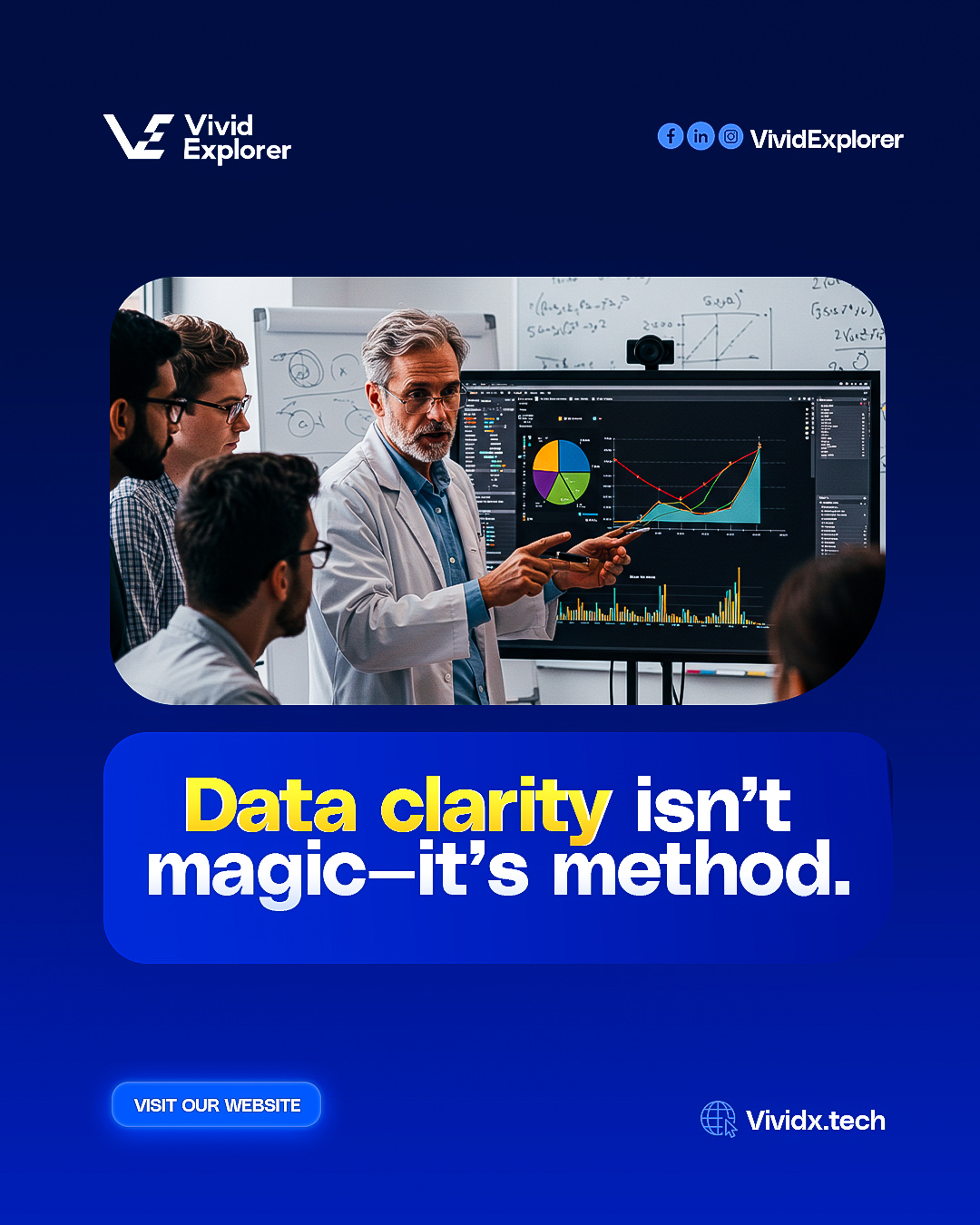
Data Clarity Isn’t Magic. It’s Method.
Your business may not need more data. It may need a better way to make sense of the data it already has. When dashboards multiply, reports become heavier, and teams still struggle to agree on what the numbers mean, the problem is rarely a lack of information. It is a lack of clarity. This article explores how organizations can move from fragmented data to meaningful insight by connecting strategy, data quality, analytics, people, and action into one deliberate method.There is a moment many business leaders know too well.
You have the dashboards.
You have the reports.
You have the analytics team.
You have more data than you had five years ago.
And yet, when an important decision needs to be made, the room still becomes uncertain.
Someone asks for another report.
Another person questions the numbers.
Someone opens a different spreadsheet.
The conversation moves from “What should we do?” to “Which numbers are correct?”
That is not a data shortage.
It is a data clarity problem.
And data clarity rarely appears by accident. It is built through the right combination of strategy, structure, technology, and human understanding.
The difference between having data and having clarity
Businesses often measure their data capability by volume.
How much data do we collect?
How many dashboards do we have?
How many systems are connected?
How frequently are reports generated?
Those questions matter, but they don't tell the whole story.
The more important question is:
Can the right person understand the right information at the right time well enough to make the right decision?
That is the real test of data maturity.
A business can have millions of records and still struggle to understand what is happening.
Another business can have fewer data sources but use them exceptionally well because its information is structured around the decisions that matter.
More information does not necessarily create more intelligence.
Better information architecture does.
Where businesses lose clarity
Data becomes difficult to use when it grows without a clear method.
Different departments may collect information for different purposes. Systems may not communicate properly. Definitions of key metrics may vary. Data may sit in isolated platforms. Reports may be manually assembled every week.
Eventually, the organization has an interesting paradox:
Everyone has information, but nobody has the complete picture.
Sales sees one part of the customer journey.
Marketing sees another.
Finance sees the financial outcome.
Operations sees what is happening behind the scenes.
Leadership receives reports from all of them.
But without a connected data strategy, these perspectives remain fragmented.
The problem isn't necessarily that any individual team is doing something wrong.
The problem is that the organization has not created a reliable method for turning these different pieces into one coherent view.
Data clarity begins with the business question
One of the easiest mistakes to make in analytics is starting with the data.
A business discovers a new dataset and immediately asks:
“What can we analyse?”
A stronger approach starts somewhere else:
“What decision are we trying to improve?”
That single change in perspective can completely alter an analytics project.
Suppose customer retention is declining.
Instead of immediately building another dashboard, leadership should first determine what it needs to understand.
Which customer segments are leaving?
When does disengagement begin?
Which products or services are associated with higher retention?
Are there operational issues contributing to churn?
Which signals appear before a customer leaves?
Now the data has a purpose.
The analytics effort is no longer about producing information.
It is about answering a business question.
Good analytics should reduce uncertainty
This is one of the simplest ways to think about the value of analytics.
Before analysis, there is uncertainty.
After analysis, there should be greater clarity about what is happening and what could happen next.
That doesn't mean analytics will always provide a perfect answer.
Business decisions rarely work that way.
But good analytics should narrow the uncertainty enough to help leaders act with greater confidence.
If a dashboard leaves executives with ten more questions but no clearer path forward, it may be visually impressive without being strategically useful.
The goal isn't beautiful charts.
The goal is better decisions.
From raw data to business intelligence
There is a journey that data must travel before it becomes genuinely useful.
Raw data → Structured data → Analysis → Insight → Decision → Action → Outcome
Every stage matters.
If the underlying data is unreliable, the analysis becomes questionable.
If the analysis lacks business context, the insight may be irrelevant.
If the insight doesn't reach the right decision-maker, nothing changes.
And if the decision isn't translated into action, the analytical investment never realizes its potential.
This is why data analytics should not exist in isolation from business strategy.
The strongest analytics functions understand both the numbers and the decisions those numbers are supposed to influence.
What does a method for data clarity look like?
There isn't one universal blueprint because every organization is different.
But a strong approach usually begins with five questions.
1. What decisions matter most?
Identify the decisions that have the greatest impact on revenue, customers, operations, risk, and growth.
2. What information supports those decisions?
Determine which metrics and data sources actually contribute to those decisions.
Not every available metric deserves executive attention.
3. Can the organization trust the data?
Data quality, consistency, governance, ownership, and definitions need to be established before insights can be trusted.
4. Can people access and understand the insight?
Even excellent analytics has limited value if the people responsible for acting on it cannot interpret it easily.
5. What happens after the insight?
This is perhaps the most neglected question.
An organization should know what action an insight is expected to trigger and how the resulting outcome will be measured.
That closes the loop.
Clarity also requires people
Technology can connect systems.
Artificial intelligence can identify patterns.
Analytics platforms can surface trends.
Automation can accelerate reporting.
But none of these automatically creates an organization that knows how to use information well.
People still have to ask better questions.
They have to challenge assumptions.
They have to understand context.
They have to recognize when a number doesn't tell the whole story.
And leaders have to create an environment where evidence can influence decisions, even when the evidence challenges existing assumptions.
That is why data transformation is as much an organizational challenge as it is a technological one.
The real objective isn't more dashboards
Businesses don't need another dashboard simply because dashboards are available.
They need analytics that answers meaningful questions.
They need data systems that reduce friction.
They need consistent definitions of what success means.
They need automated flows that reduce repetitive reporting.
They need people who can translate analysis into action.
And they need leadership that understands that data is not merely something to review at the end of a reporting cycle.
It is an asset for making decisions continuously.
That is what creates data clarity.
Not magic.
Not another expensive platform.
Not a dashboard with more charts.
A method.
A deliberate connection between business strategy, reliable data, meaningful analysis, human judgment, and measurable action.
At VividX, we help organizations build that connection.
Because the value of data is not measured by how much information a business possesses.
It is measured by how confidently that information can be turned into decisions that move the business forward.
Data clarity isn't magic. It's method.
Similar publication
 Don't Buy More Tools. Fix the Strategy First.
Technology should make a business simpler, smarter and more responsive. But when every new problem leads to another platform, dashboard…
Read More Why Leaders Must Become Data Storytellers
Data can tell a leader what is happening. But leadership requires something more: understanding why it matters, what could happen…
Read More Business Speed Increased. Manual Processes Didn't Survive.
Manual processes do not announce their inefficiency. They just quietly consume the time, attention, and accuracy your business needs to…
Read More AI adoption shifted from "experiment" to "essential advantage."
78% of organizations now use AI in at least one business function. The experiment is over. The question is no…
Read More