


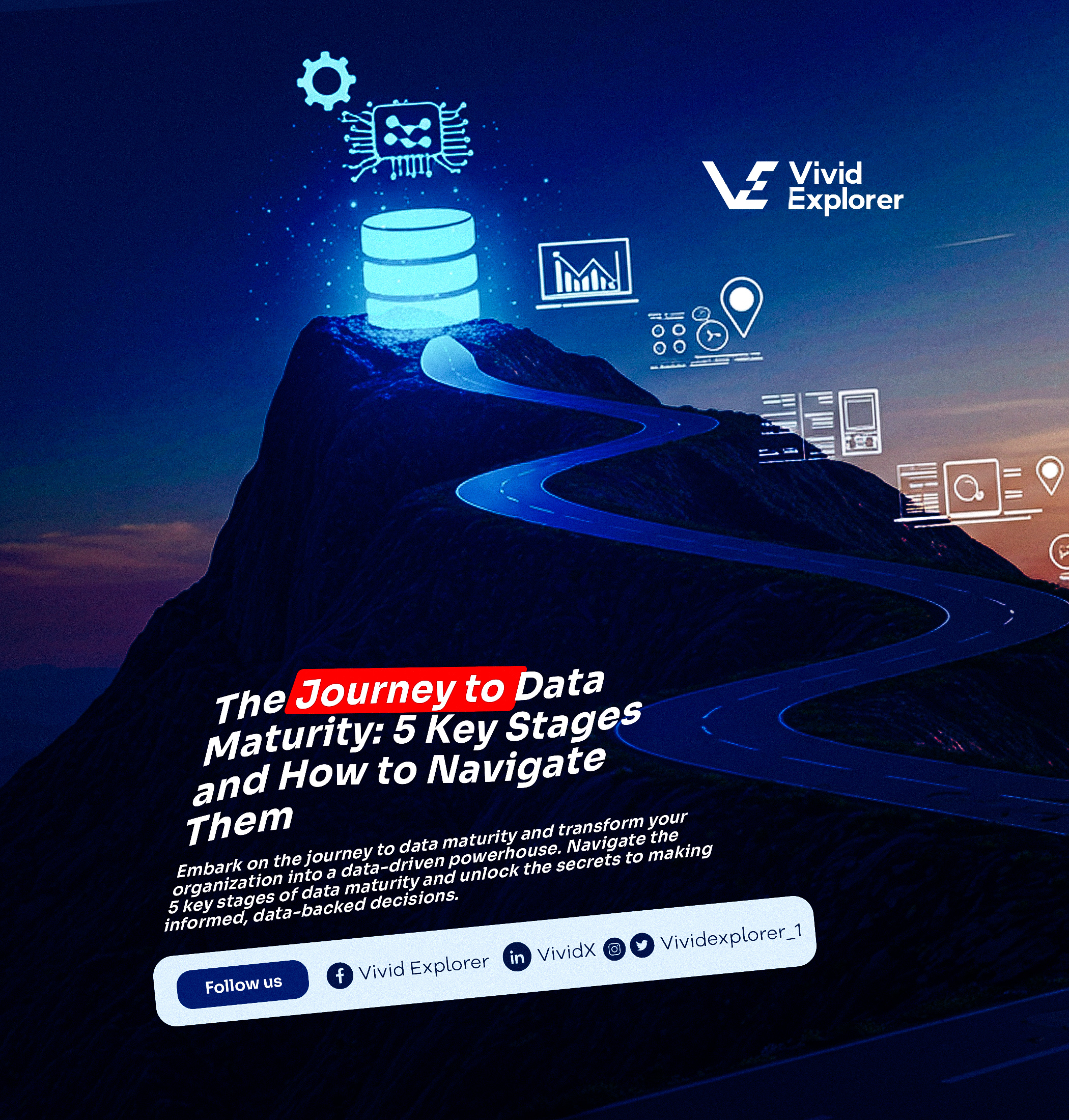
The Journey to Data Maturity: 5 Key Stages and How to Navigate Them
The journey to becoming a data-driven organization happens in stages. From reactive reporting to predictive intelligence, each level of data maturity unlocks new capabilities and competitive advantages. Understanding where you stand, and how to move forward, is key to transforming data into a true driver of business performance.Every organization wants to be data-driven.
But in reality, becoming truly data-driven is not a switch you flip.
It’s a journey, one that requires structure, clarity, and intentional progress.
Many businesses invest in tools, hire talent, and build dashboards, yet still struggle to translate data into consistent, high-quality decisions.
The reason is simple:
They haven’t yet reached data maturity.
What Is Data Maturity and Why It Matters
Data maturity refers to how effectively an organization collects, manages, analyzes, and uses data to drive decisions.
At lower levels of maturity, data is fragmented, inconsistent, and underutilized.
At higher levels, it becomes a strategic asset, guiding decisions in real time and shaping long-term direction.
The difference between these stages is not just technical.
It directly impacts performance, agility, and competitive advantage.
The 5 Key Stages of Data Maturity
1. The Reactive Stage
At this stage, data exists, but it is largely unstructured and underused.
- Reports are created manually
- Data is scattered across multiple tools
- Insights are generated only when needed
- Decisions rely heavily on intuition
Organizations here are constantly reacting, rather than planning.
The Challenge: Lack of visibility and consistency
The Focus: Begin organizing and centralizing data sources
2. The Structured Stage
Data begins to take shape, and basic reporting systems are introduced.
- Standard reports are created regularly
- Data is partially organized
- Some processes become repeatable
- Visibility improves slightly
However, reporting is still time-consuming and often delayed.
The Challenge: Slow reporting cycles
The Focus: Improve data quality and introduce automation
3. The Integrated Stage
At this level, data systems start working together.
- Multiple data sources are connected
- Dashboards provide a unified view of performance
- Data consistency improves across teams
- Reporting becomes more reliable
Organizations begin to gain clearer insight, but speed and proactivity may still be limited.
The Challenge: Limited real-time insight
The Focus: Strengthen integration and enable faster access to data
4. The Optimized Stage
Data is no longer just reported, it is actively used to improve performance.
- Real-time or near real-time insights are available
- Processes are automated
- KPIs are clearly defined and aligned
- Teams rely on data for day-to-day decisions
At this stage, organizations move from reacting to optimizing.
The Challenge: Scaling impact across the business
The Focus: Embed data into decision-making culture
5. The Predictive Stage
This is where data maturity reaches its highest level.
- Predictive analytics and forecasting are in place
- Decisions are proactive and forward-looking
- Risks and opportunities are identified early
- Data drives both strategy and execution
Organizations here operate with confidence, speed, and precision.
The Challenge: Continuous innovation
The Focus: Refine models and expand capabilities
Why Many Organizations Get Stuck
Despite progress, many businesses struggle to move beyond the middle stages.
Common barriers include:
- Data silos across departments
- Poor data quality and governance
- Over-reliance on manual processes
- Misalignment between data teams and business leaders
These challenges slow down progress and limit the value data can deliver.
How to Navigate the Journey Successfully
Moving through the stages of data maturity requires more than tools.
It requires a clear strategy:
1. Start with Business Objectives
Define what decisions you want to improve and align your data efforts accordingly.
2. Build a Strong Data Foundation
Ensure your data is clean, consistent, and accessible.
3. Invest in Integration and Automation
Reduce manual work and enable real-time insight.
4. Align Data with Decision-Making
Structure your data systems around how your organization operates and makes decisions.
5. Continuously Evolve
Data maturity is not a final destination, it’s an ongoing process of refinement and growth.
How Vivid Explorer Supports the Journey
At Vivid Explorer, we help organizations navigate each stage of data maturity with clarity and precision.
This includes:
- Assessing current data capabilities
- Designing scalable data strategies
- Integrating systems for unified visibility
- Automating reporting and insight delivery
- Implementing predictive analytics for forward-looking decisions
The goal is not just to advance through stages, but to ensure that each step delivers measurable value.
Final Thought
Becoming data-driven is not about having more data.
It’s about using data with purpose, consistency, and speed.
Organizations that successfully navigate the journey to data maturity gain more than insight.
They gain the ability to act with confidence in an increasingly complex environment.
If your organization is somewhere along this journey, the question is not whether you have data.
It’s whether your data is truly working for you.
Similar publication
 Why Leaders Must Become Data Storytellers
Data can tell a leader what is happening. But leadership requires something more: understanding why it matters, what could happen…
Read More Data Clarity Isn’t Magic. It’s Method.
Your business may not need more data. It may need a better way to make sense of the data it…
Read More Business Speed Increased. Manual Processes Didn't Survive.
Manual processes do not announce their inefficiency. They just quietly consume the time, attention, and accuracy your business needs to…
Read More AI adoption shifted from "experiment" to "essential advantage."
78% of organizations now use AI in at least one business function. The experiment is over. The question is no…
Read More