


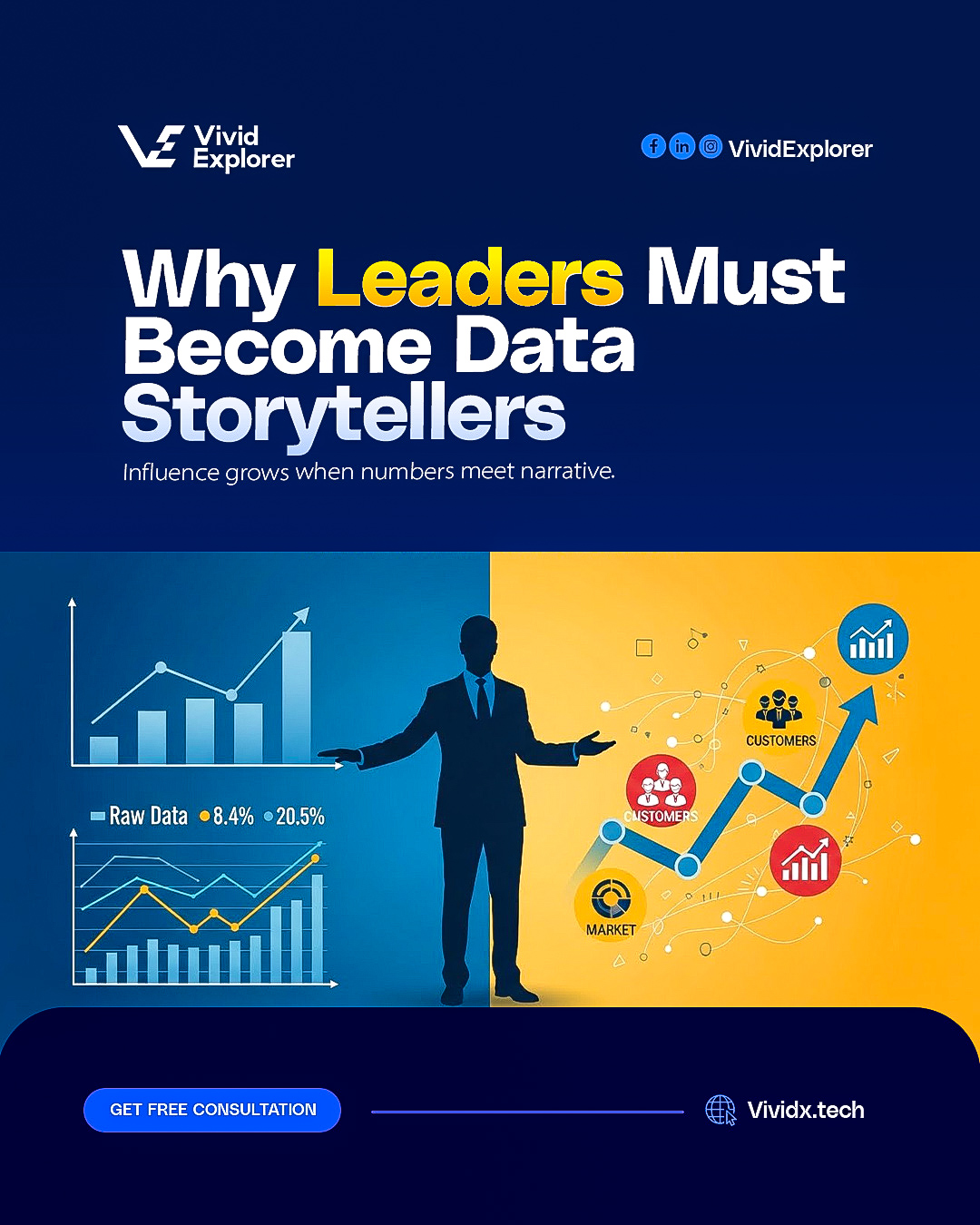
Why Leaders Must Become Data Storytellers
Data can tell a leader what is happening. But leadership requires something more: understanding why it matters, what could happen next, and what action the evidence supports. In a world where organizations have access to more data than ever, the ability to turn complex analysis into a clear, credible and actionable story is becoming a critical leadership skill. This article explores why data storytelling matters, how leaders can communicate evidence more effectively, and what it takes to move an organization from simply consuming data to making better decisions with it.When numbers are clear but the decision is still unclear
A leadership team can sit in a room with all the right numbers and still walk away without a clear decision.
Revenue is on the screen.
Customer retention is being tracked.
Operational costs have been analysed.
Forecasts have been prepared.
The dashboard looks impressive.
And then someone asks:
“So, what are we actually going to do about it?”
That question reveals something important about data.
Information does not automatically create understanding.
And understanding does not automatically create action.
This is where data storytelling becomes a leadership capability.
Not the ability to make charts look attractive.
Not the ability to put a few numbers into a presentation.
It is the ability to take complex evidence, understand what it means in a business context, and communicate it in a way that helps people see the problem, understand the opportunity and act with confidence.
The problem isn't always the data
Businesses have invested heavily in collecting and analysing information.
But there is still a gap between what analytics teams discover and what decision makers actually understand.
An analyst might identify a significant change in customer behaviour.
A finance team might uncover a worrying cost trend.
A marketing team might discover that a particular segment is becoming significantly more valuable.
The insight can be completely correct.
Yet if it is presented as a collection of charts and percentages without context, the audience is left to interpret the meaning for themselves.
That creates friction.
And when decisions matter, friction is expensive.
Leaders don't simply need to know what happened.
They need to understand:
What changed?
Why did it change?
Why does it matter?
What happens if we do nothing?
What opportunity exists?
And what should we do next?
That is where storytelling turns analysis into influence.
Numbers tell you what. Context tells you why.
Imagine a business discovers that customer churn increased by 12%.
That's important.
But the number alone isn't the story.
Perhaps most of the churn came from customers who had been with the company for less than six months.
Perhaps those customers were concentrated in one product category.
Perhaps customer complaints increased shortly before they left.
Perhaps the organization recently changed its onboarding process.
Now the conversation is different.
The number has become a narrative.
Churn increased.
A particular customer segment is driving the increase.
The change began after a specific operational shift.
The evidence suggests a weakness in onboarding.
Improving the first 90 days of the customer journey could therefore become a priority.
The data hasn't changed.
The understanding has.
And that difference can change a decision.
Great data storytellers don't manipulate the numbers
This distinction matters.
Data storytelling should never mean dressing up weak evidence to make a preferred conclusion look convincing.
Quite the opposite.
Good data storytelling makes the evidence easier to interrogate.
It gives people enough context to understand where the conclusion came from.
It separates facts from assumptions.
It acknowledges uncertainty.
And it makes the implications visible without overstating what the data can prove.
That is particularly important for senior leadership.
Executives don't need analysts to tell them what they want to hear.
They need people who can help them see what the evidence is actually saying.
Even when the answer is uncomfortable.
Why this matters for leadership
Leadership is fundamentally about making decisions under uncertainty.
There will rarely be perfect information.
There will always be competing priorities, incomplete datasets, changing markets and unexpected events.
The advantage isn't having every answer.
It is being able to extract the most useful signal from the information available and communicate it effectively.
A leader who understands data can ask better questions.
A leader who can communicate data can create better alignment.
And a leader who can connect data to business outcomes can move an organization from analysis to action.
That is why data storytelling shouldn't belong exclusively to analysts.
It belongs in the leadership toolkit.
From dashboard to decision
A dashboard might tell a CEO that sales are declining.
A data story helps answer the questions that follow.
Which markets are affected?
Which products are responsible?
When did the decline begin?
What changed around that time?
Is this a temporary fluctuation or a structural problem?
What does the forecast suggest?
Which intervention is most likely to make a difference?
The dashboard provides visibility.
The story provides direction.
Neither replaces the other.
The real value emerges when they work together.
The strongest data stories follow a simple logic
They don't overwhelm the audience with everything the analysis uncovered.
They identify what matters.
A useful structure is:
The situation: What is happening?
The evidence: What does the data show?
The explanation: What appears to be driving it?
The implication: Why should the business care?
The decision: What needs to happen next?
This sounds simple.
But it requires discipline.
Because analysts often see hundreds of interesting patterns.
Leaders don't have time to act on hundreds of patterns.
They need to know which ones matter.
Data literacy makes storytelling stronger
There is another reason organizations should invest in data literacy.
The better people understand data, the better they become at questioning it.
A data-literate executive is less likely to accept a convenient number without asking where it came from.
They can distinguish correlation from causation.
They understand the limitations of a forecast.
They recognize when a metric is being presented without sufficient context.
And they can challenge an insight constructively.
That creates healthier decision-making.
Instead of leadership simply consuming analytics, leadership participates intelligently in the analytical process.
The real measure of a data story
A presentation isn't successful because everyone says the charts look good.
It isn't successful because the audience understands every technical detail.
It is successful when the right people leave with a clearer understanding of the situation and know what needs to happen next.
That is the real test.
Ask yourself:
Did the analysis change the conversation?
Did it reduce uncertainty?
Did it influence a decision?
Did someone take action because of it?
If the answer is yes, the data has moved beyond reporting.
It has created influence.
The future belongs to leaders who can connect evidence with action
As businesses become increasingly data-rich, the ability to communicate insight will become even more important.
Artificial intelligence can process enormous amounts of information.
Analytics platforms can identify patterns.
Automation can deliver insights faster.
But someone still has to determine what matters.
Someone has to provide context.
Someone has to explain the implications.
And someone has to help people move from “Here is what the data says” to “Here is what we should do about it.”
That is the real power of data storytelling.
It doesn't make data more intelligent.
It makes intelligence more understandable.
And when intelligence becomes understandable, it becomes much easier to act on.
At VividX, we believe the future of analytics isn't simply about producing more sophisticated insights.
It is about making those insights useful to the people responsible for turning them into business outcomes.
Because the most valuable analysis isn't the one that fills a dashboard.
It is the one that changes a decision.
Similar publication
 Data Clarity Isn’t Magic. It’s Method.
Your business may not need more data. It may need a better way to make sense of the data it…
Read More Business Speed Increased. Manual Processes Didn't Survive.
Manual processes do not announce their inefficiency. They just quietly consume the time, attention, and accuracy your business needs to…
Read More AI adoption shifted from "experiment" to "essential advantage."
78% of organizations now use AI in at least one business function. The experiment is over. The question is no…
Read More The Future of Data Collection and Its Impact on Business
Data collection is evolving from passive accumulation to intentional design. As real-time systems, distributed architectures, and privacy-first frameworks reshape how…
Read More